The Modern Google Ads Playbook: 6 Core AI Shifts to Master
TLDR
The Core Framework: Current Status of the Big Shifts
✅ Nano Banana Pro: Fully deployed in Asset Studio.
✅ Ads Advisor (Renamed to Ask Advisor annouced at 2026 GML: Active interface partner.
Smart Bidding Exploration: A new setting where you accept lower ROAS in exchange for finding "new" customers.
My Take: These tools are powerful but dangerous if left on auto-pilot.
Introduction: Beyond the Hype
In marketing, the only constant is change.
If I could start every single blog article with that, I would, and we all know it's true!
We marketers are perpetually sorting through a flood of announcements, trying to figure out what the heck’s going on and distinguishing minor tweaks from fundamental shifts. It’s easy to become numb to the endless cycle of "new features" and "product updates." We have to determine: is this a good update? Is it just a rebrand?
The foundational shifts that rolled out over the last year fundamentally re-architected Google Ads around a collaborative AI framework. We are living in that reality right now in 2026.
This was the year Google Ads moved beyond integrating AI as a helpful feature and instead re-architected its core products around a collaborative AI framework.
We lived through the machine learning bingo card and the automation bingo card, and here we are again with AI. This isn't just another update; it’s a fundamental change in how advertisers must strategize, how we create, and how we measure performance.
This post cuts through that noise.
I’ve analyzed the year's developments to bring you the six most surprising and impactful updates that every marketer needs to understand and act on now. These are the ones that I feel change everything for us as PPCers.
1. Performance Max Is Finally Opening the Black Box
I think this was the biggest historical change that has been made to Performance Max campaigns.
The biggest historical challenge with PMax has been the trade-off between its power and its opacity. Up until this year, we were admittedly sacrificing some control and some visibility and it was a "black box" that left many advertisers hesitant to invest fully or to fight what it was doing. Despite PMax’s impressive results, this lack of transparency always overshadowed it.
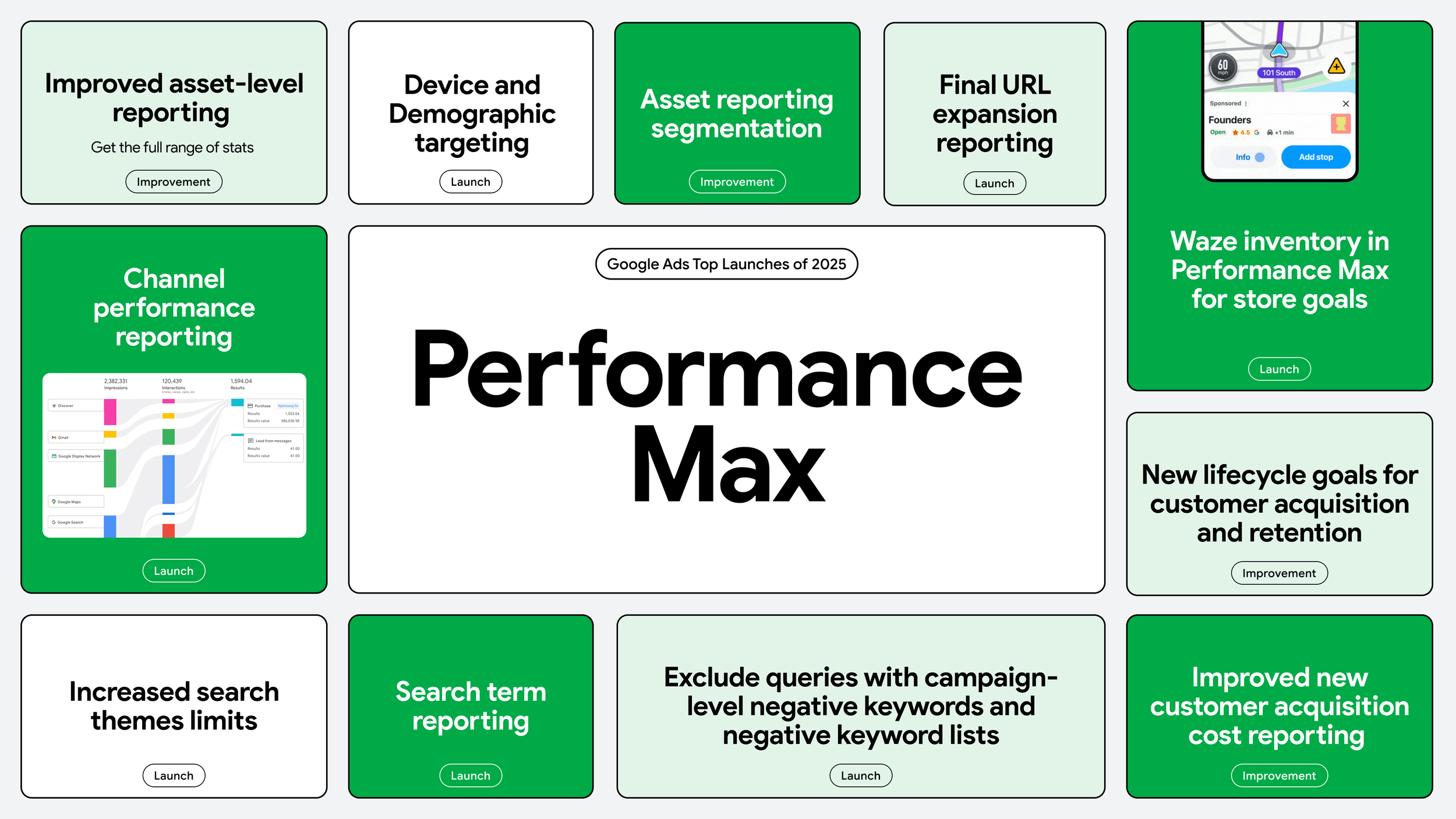
In 2025, Google’s AI began earning a lot of that trust back by showing us more data than ever before.
The key updates that address this include:
Full Search Terms Reporting: Advertisers can now access the same level of granular search term data within PMax that they are accustomed to in standard Search campaigns.
Channel-Level Performance Reporting: This was really, really huge. You can now see exactly how PMax is delivering results across Search, Shopping, YouTube, and other channels. That data was able to validate what it was doing, showing us when the campaigns were leaning into YouTube or other upper-funnel activities.
New Advertiser Controls: Crucial new levers for control have been added, including campaign-level negative keywords (up to 10,000 per campaign), allowing for very creative things—like essentially running a brand and a non-brand PMax. We also got the ability to apply demographic and device targeting.
This transparency goes beyond search terms. We got richer new asset reporting where we were able to look at the numbers across assets for impressions, clicks, conversions, so we could tell which headline, description, and image are working. Obviously, any of this data is a game-changer because we can swap out things that aren't converting and answer questions for our clients and stakeholders. This provides the data and control necessary for strategic optimization, giving marketers the confidence to invest more heavily in Google’s most powerful automated campaign type.
2. Your New Colleague is a Google AI
For me, the evolution of AI in Google Ads has reached a new paradigm: a shift from using AI tools to using AI as more of a partnership and a conversation.
Google introduced two new "Agentic" solutions that function as active assistants within its platforms. Meet your new team members:
Ask Advisor: An embedded partner that helps you manage campaigns, troubleshoot policy issues, create new assets, and analyze performance directly within the Google Ads interface. I always look at these tools as conversation starters. They give us a framework to open up that conversation with stakeholders, which is sometimes a missing piece. They’re an average maker, helping to bring up the bottom half of marketers and pushing the more advanced ones to continue to be more advanced.
⚠️ Warning: Don't Let "Ask Advisor" Break Your Strategy
Google's new AI agents are designed to spend your budget, not save it. If you see the "Ads Advisor" pop-up in your account, do not auto-apply its suggestions without a human review.
If you want to understand how Google actually spends your daily budget — and how to protect it from automation — read my guide on [Google Ads budget pacing].
Confused by these new changes? Don't let an algorithm guess your strategy. [Book a 1-Hour Audit with Sarah] — I'll show you exactly which of these new "features" to turn OFF to protect your ROI.
Analytics Advisor: A conversational analysis assistant in Google Analytics for exploring the customer journey. Also, it maintains conversational memory, which I think is fantastic, allowing you to ask natural language follow-up questions for a continuous and iterative workflow. Honestly, I've always found GA4 harder, so this again levels me up as a starting point.
This move signals a future where we can eventually offload complex data analysis and routine optimization tasks to these dedicated AI agents. This frees up human strategists to focus on higher-level planning, creative direction, and overall business growth. The experts still matter! We know that, but these tools do help bring up the bottom and level up that playing field.
3. Your TV is Now a Storefront
I picked this because TV being a storefront is extremely impactful; it changes the way people are able to buy. I have three teenagers downstairs monopolizing the biggest TV in the house watching YouTube!
For years, Connected TV advertising excelled at brand-building and awareness but has always struggled with that conversion point. It makes it so advertisers don't want to do it because we all love the conversion. In 2025, Google has started to aggressively collapse that funnel, turning YouTube on the big screen into a fully transactional surface.
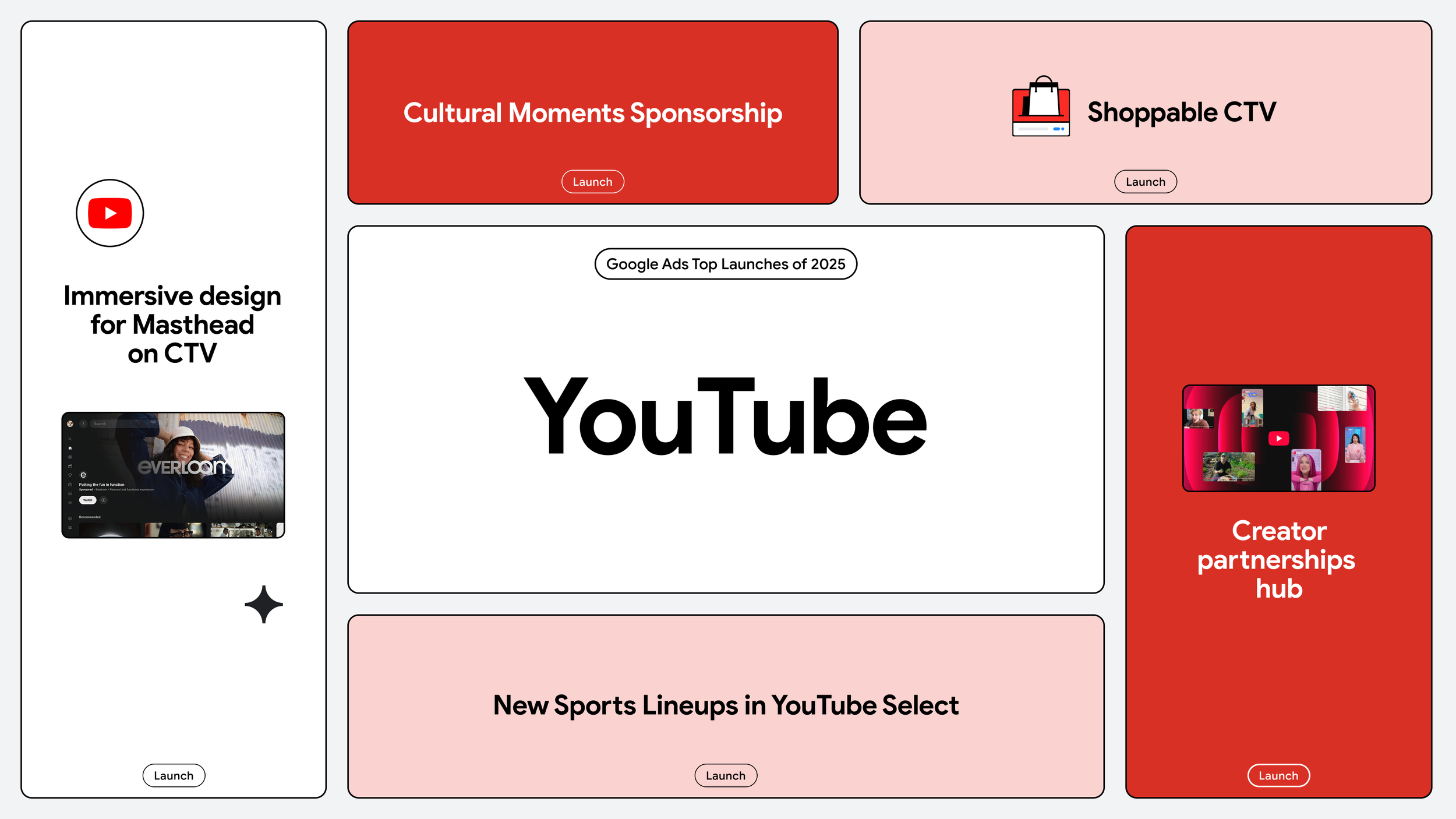
This isn't just about putting an awkward "buy" button on the TV; it’s about making brand integrations during cultural moments instantly shoppable. The new Shoppable Connected TV (CTV) feature allows viewers to browse products directly from their television during an ad. A "send-to-phone" feature then enables them to seamlessly continue the shopping journey on their mobile device.
The strategic impact is absolutely immense. It's another connection point to allow brands to track what's happening more, to have that conversion point right then, right there. It incentivizes brands to get really creative and have a really good deal to make me want to jump off my couch and make that purchase decision. Ultimately, for retail and e-commerce brands, it means the marketing funnel now starts and can potentially end right on the living room TV where it traditionally was not.
4. Google's AI Is Auditioning to Be Your Creative Director
High-quality, varied creative is essential for performance, but producing it at scale has always been a significant resource drain. Again, this is going to get old, but it levels the playing field. Small advertisers that don't have the creative teams can make images at scale with a lot of these tools right there in the interface.
If you’re running on a very small budget, start here: [Is $20 a day enough for Google Ads?].
Asset Studio, the new one-stop-shop for creative needs in Google Ads, is now powered by a new generative model called Nano Banana Pro. This introduces several impactful capabilities:
Generate images of your products in new, photo-realistic lifestyle scenes. As strategic marketers, we’re always saying that you have to have lifestyle images, and now we can do that using natural language.
Edit existing assets simply by using natural language prompts.
Showcase up to five different products together in a single generated image.
Edit images in bulk, a massive time-saver for e-commerce and retail brands.
This allows businesses of any size to produce a continuous stream of professional, high-impact ad creative without needing a large in-house design team or a significant agency budget. We can store things in Asset Studio so they don't get lost in the interface or on our hard drive.
5. Google is Building a Cross-Platform 'Source of Truth'
I don't feel like you've been in marketing long enough if you don't know that everyone is obsessed with attribution. As people that want to keep our jobs, we can’t just be spending money and saying, "it raises brand awareness, we think." We have to prove things. We can't just do what we know in our heart is correct. This is an art and a science, and Google is helping us with the science piece. Job security!
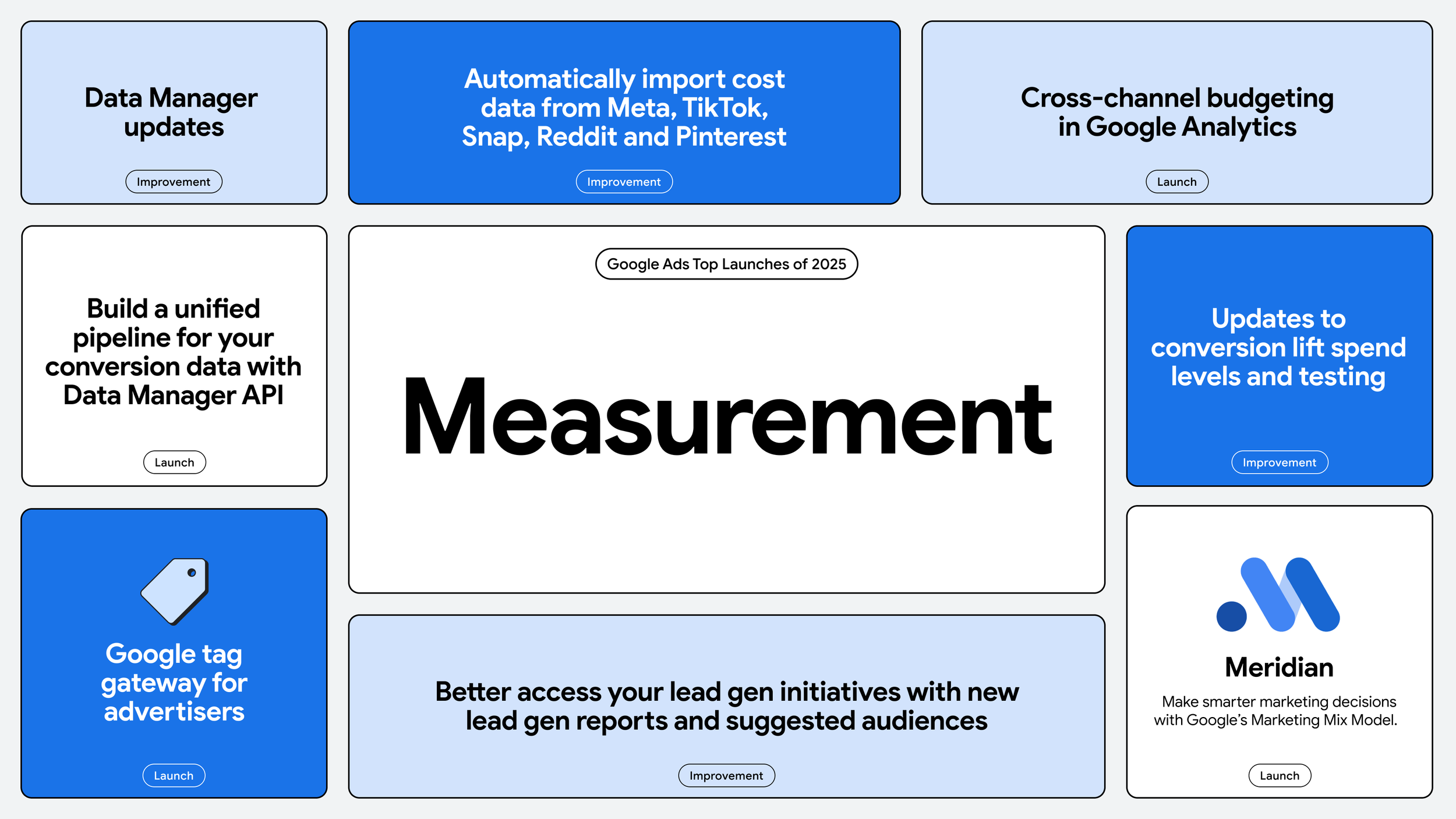
By combining an open-source model with new cross-channel data ingestion, Google is positioning its ecosystem as the central source of truth for marketing performance—even for non-Google channels.
The first pillar of this strategy is Meridian, Google's new Marketing Mix Model (MMM). In a surprising move, Google released it as open-source, providing a transparent and credible methodology for strategic budget planning. Crucially, it enables calibration with your incrementality experiments to "measure what truly moves the needle." That's the old, "If I turn off YouTube, what happens to my non-brand search?" or "What happens to in-store purchases if I turn off non-brand search?"
The second pillar is the new ability to import cost data directly into Google Analytics from other platforms like Meta, TikTok, and Pinterest. This is huge because it's one central place. By combining Meridian’s transparent modeling with holistic, cross-channel cost analysis in GA, Google is providing the tools for advertisers and CMOs to finally build a unified view of their entire marketing mix.
6. Smart Bidding Can Now Explore for Untapped Customers
A common challenge for mature ad accounts is finding new pockets of growth. I know we all think that we are the smartest marketers, but consumers are always changing, and finding those pockets of growth is incredibly difficult, especially in mature accounts. The new Smart Bidding Exploration feature directly addresses this by empowering Google's AI to find new customer segments for you.
The feature allows advertisers to use flexible ROAS targets, essentially giving the bidding algorithm permission to explore new, potentially valuable traffic that it might otherwise ignore. We’re comfortable testing with this; we’re comfortable accepting a lower ROAS.
The initial results out of Google are impressive:
Campaigns using this feature saw, on average, an 18% increase in unique search query categories with conversions—new random terms that us marketers think, no way could this work, but it actually works.
Keep in mind, exploration only works if you have enough data — here’s my [100‑Click Rule] for making statistically valid decisions.
A 18% increase in total conversions. I’ll take that any day.
Is Your Account Stagnant?
Smart Bidding Exploration is powerful, but it requires a very specific setup to avoid burning cash on low-quality traffic.
If you’re not sure whether your budget can support exploration, calculate your real daily floor using my [Reverse‑Budget Formula].
If you want to test this new "Growth Mode" safely, let's set up the guardrails together. [Request a Strategy Session] to see if your account is ready for Exploration Mode.
In practical terms, this means Google’s AI is no longer just optimizing for the customers that you already know about. It is now actively tasked with discovering and converting customer segments you might have missed, creating a powerful new avenue for scalable growth.
Conclusion: The AI Co-Pilot is Here
Looking back at the major shifts of 2025, a single, clear theme emerges: AI has evolved from a background optimization engine into an active, collaborative partner for marketers. The era of the AI co-pilot has officially arrived. It's only going to get better and better and better. I think it would be negligent as marketers not to try these tools, not to test them, and not to give them our best, most open mind.
Always, always remember that these updates are designed to augment, not replace, the skills of the human marketer. The strategy is where the big bucks are made, and that is where the success lies. We are being freed up from the day-to-day and the low-level decision-making that we had to do in the past.
As these AI co-pilots become more capable, the core role of a digital marketer will continue to evolve.
I want to know what you think! And if you want a partner who knows how to steer these AI tools rather than just letting them drive, [reach out to me here]. The tools have changed, but the need for a human strategist is higher than ever.
Watch full video here on YouTube OR the 6 Google Ads Changes I think are the most impactful: