Platform Behavior Hub: Protecting Small Business Ads from Automation Drift
Updated: Jan 20, 2026
Why Platform Behavior Analysis Matters in an AI-Driven World
I analyze the behavioral patterns of Google, Bing, Reddit, and emerging AI search platforms. My goal is to help small businesses make safer, data-driven marketing decisions in an era of rising ad costs and opaque automation.
To do this, I outline the formal rules and policies, such as Community Guidelines and Off-Platform Behaviors Policy, that structure platform behavior analysis and provide a clear overview of acceptable and unacceptable actions.
With 17 years of experience in Google Ads management, I’ve moved beyond “how-to” tutorials. I focus on Platform Behavior Analysis which is understanding the motivations behind the algorithms and the code of conduct or standards that platforms enforce, so you can protect your margins when you are running online ads.
Why Platform Behavior Analysis Matters in an AI-Driven World
On the internet in 2026 platforms are shifting faster than most businesses can keep up with. Costs rise, automation gets more opaque, and every platform insists its AI will “optimize” for you — even when the results feel unpredictable or misaligned.
Full post: Search Isn’t Matching Intent — It’s Matching Predictions: Inside the Predictive Era
For the clients I work with there is the pressure to keep up and the pressure to understand why changes are happening to be prepared for the future.
This hub is that place. I break down how platforms actually behave, not just how to use them. I also cover the motivations of the platforms.
Note: Interpreting platform changes requires context and caution, as rapid shifts and updates may not always align with your business goals or previous strategies.
In my writing analyze:
why in 2026, rising CPCs (Cost-Per-Click) and opaque ad automation are the biggest threats to small business margins
where algorithms over‑index
how automation finds (and traps you in) pockets of performance and wastes your money
which platforms are safer for small budgets and where you can trust or not trust automation
how to interpret platform changes without panic
The motivation and moves the platforms make to influence how you market
This is not news reporting. This is platform behavior analysis — written for any business that feels vulnerable to the shifts in algorithms and platforms.
The 2026 Shift: How AI Agents are Capturing the Funnel
Platforms — not AI — are taking over the funnel.
New AI agents make the recommendation, own the transaction, and cut brands out of the data loop. Eligibility now depends on clarity, structure, and signals the AI can read.
Related: Search Isn’t Matching Intent — It’s Matching Predictions
Microsoft’s new Copilot Checkout and Brand Agents are the clearest example of this shift so far — a full upstream move where the platform owns the recommendation, the transaction, and the data.
Full post: Microsoft Announces Copilot Checkout and Brand Agents
This might be one of the most important posts I have written on this blog. If you read this post you will understand how AI is changing purchasing decisions.
Full post: AI Isn’t the Disruptor. The Platforms Are.
To move beyond news reporting, I use a specific diagnostic framework to evaluate every platform update. This allows us to look past the "optimization" claims and see the actual economic impact on your small business.
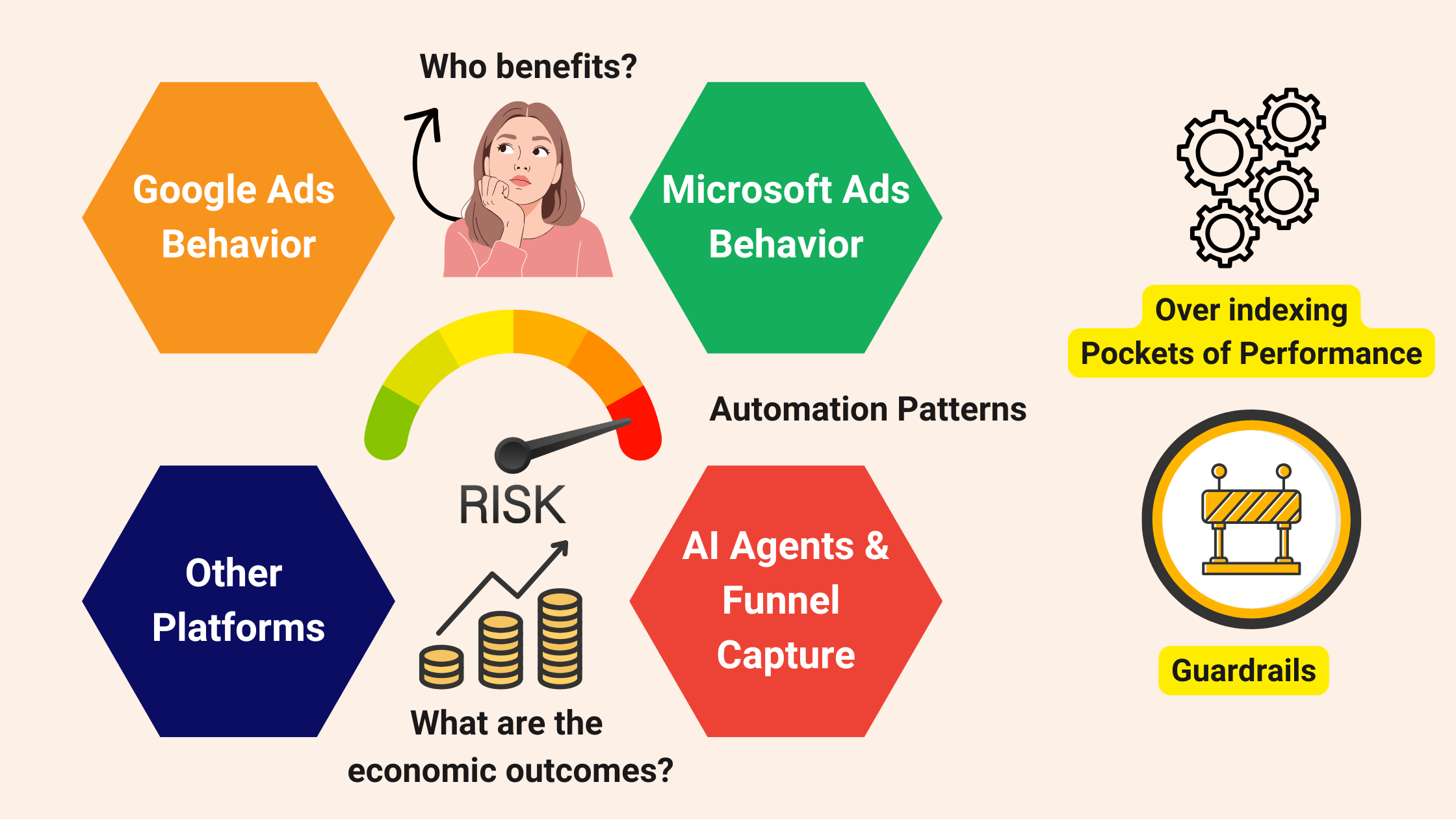
This framework forces us to ask two critical questions with every change: “Who actually benefits?” and “What are the true economic outcomes?”. By identifying recurring Automation Patterns—like over-indexing and pockets of performance—we can build the Guardrails necessary to protect your margins. The result of certain automation patterns or platform decisions can be significant, often leading to changes in account performance, eligibility, or even penalties that directly impact your business.
Why My Content Is Different
I really believe when you look at all the platforms you start to see patterns, and then using those patterns you can learn:
Should you even play the game - because every platform has a game that has to be played at some level
Are there better ways to advertise
What is really going to drive your business forward
How do you protect yourself for the future
Google Ads Behavior: Protecting Small Budgets from Over-Indexing
Identifying Automation Drift: How Google’s Smart Bidding and Performance Max impact small business ad budgets.
After 17 years inside Google Ads, I’ve watched Smart Bidding and Performance Max over‑index in predictable ways—ways that most small budgets can’t absorb. Actions taken by automation or users are directly linked to your account, and enforcement measures, such as warnings or bans, are applied based on activity associated with that account. If certain actions violate platform policies, this can result in removal or being removed from the ad program, impacting your ability to advertise or afford advertising in this environment.
What you’ll find here:
Why Google Ads feels more expensive
How broad match actually behaves
The risks of Performance Max over-indexing and how to regain control of your Google Ads budget.
How Google’s documentation drift affects advertisers
Where small budgets get punished
How to test Google automation safely
This diagnostic breakdown explains how Campaign Total Budgets shift Google Ads from an intent‑based auction into a predictive, investment‑style system — and why this change increases CPCs, accelerates over‑indexing, and puts evergreen campaigns at risk.
Read the full analysis → The Architecture of Urgency: Decoding the Behavioral Motivations of Google Ads Campaign Total Budgets
Microsoft & Bing Ads: The Stable Alternative for Businesses
Why Bing is quietly outperforming for certain service businesses and how it behaves differently from Google.
Bing’s ad platform often delivers lower CPCs and less competition for many service-based businesses, making it a valuable alternative to Google. Unlike Google, Bing’s automation and policy enforcement can be less aggressive, allowing for more flexibility in campaign setup and management.
However, it’s important to note that enforcement actions or policy decisions on Bing may be applied at the discretion of the platform or auto moderators, meaning individual circumstances are evaluated subjectively. This can result in different outcomes for similar cases compared to Google, so understanding platform behavior is key when diversifying your paid search strategy.
What you’ll find here:
Why Bing CPCs are cheaper
Why Bing is more stable
How Bing handles automation differently
Why Bing is a protective channel for therapists and service businesses
How Bing fills the gaps Google created
Reddit Ads: High-Volatility Opportunity for Small Brands
How Reddit’s conversation‑driven signals create both opportunity and volatility.
What you’ll find here:
Why Reddit is cheaper
Reddit Ads for Small Business: Leveraging community signals without the algorithm volatility of Google.
Why Reddit Max campaigns over‑index
How community volatility affects performance
When Reddit Ads are a smart alternative — and when it isn’t
Full Post: How Reddit’s Automation Over‑Indexes and Why It’s Risky for Small Budgets
Automation Behavior Patterns Across Platforms
The cross‑platform behaviors that shape cost, stability, and performance.
To master platform behavior, you must understand how the scope of behaviors is managed across different advertising ecosystems. In the PPC world, "behaviors" are the automated tendencies of an algorithm—such as how a "Maximize Conversions" bid strategy reacts to a sudden spike in search volume.
These behaviors are essentially attached to your campaign controls and bidding objects. Their scope determines how they interact with your daily budget and your broader account lifecycle. You can influence these patterns by adding specific properties to your campaigns—such as negative keyword lists, data exclusions, or programmatic rules. These allow you to extend platform functionality and regain oversight without surrendering your entire margin to the "black box" of AI.
Additional functionality can be unlocked through automation patterns like Portfolio Bid Strategies and Shared Budgets, which improve spend integration. By understanding how your keywords and ad groups interact with these automation patterns, you can build a more resilient and functional advertising engine that resists automation drift.
What you’ll find here:
Over‑indexing
Pockets of performance
Loss of control
How automation collapses structure
How to run controlled tests
How to interpret algorithm behavior
Protective PPC: Strategic Guardrails for Small Business Owners
Emotionally intelligent, diagnostic guidance for small businesses navigating rising costs.
When scaling PPC campaigns, it is crucial to prioritize account security and budget integrity by implementing automated guardrails. Verifying the accuracy of your tracking connection is the first step before proceeding with high-spend platform actions.
Effective protective strategies often involve verification steps—such as identifying and excluding invalid traffic (bot clicks) to ensure that only "human" high-intent users are clicking your ads. This helps ensure that authorized budget spend is directed toward genuine leads rather than fraudulent activity.
The timing of these measures is essential; applying protective strategies during peak auction times or seasonal surges can significantly influence the effectiveness of your ROI and help mitigate the risks of overspending. For more detailed information on maintaining brand safety, please see our behavior reference on algorithmic bidding or consult our policy reference for platform compliance.
What you’ll find here:
How to choose the right platform
How to avoid misaligned spend
How to build guardrails
How to interpret cost spikes
How to protect yourself from automation drift
How to make decisions without panic
Full Post: How the 2026 PPC Landscape Has Changed — Introducing Protective PPC™
Off-Platform Behaviors: The Hidden Influences on Ad Performance
When it comes to digital advertising, and paid ads what happens outside the boundaries of a single platform can be just as important as what happens within it. Off-platform behaviors which are actions your potential customers take on other websites, apps, or even in the real world, can dramatically influence the performance of your ads, often in ways that are invisible to most advertisers.
For example, a user might research your service on a review site, compare prices on a competitor’s app, or see a recommendation in a social media group before ever clicking your ad. These off-platform activities shape intent, affect conversion rates, and can even trigger or suppress your ads depending on how platforms interpret user signals. Additionally, external events, like a trending news story or a sudden change in local regulations, can shift user behavior overnight, impacting your campaign’s effectiveness without warning.
The challenge for small business advertisers is that most ad platforms only provide data on what happens within their own ecosystem. This limited view can make it difficult to respond to changes in user behavior or to control the full customer journey. If you’re only reviewing platform-reported metrics, you might miss the bigger picture—leading to misaligned spend or missed opportunities. This is an area I focus on with my PPC coaching clients.
To regain control, it’s essential to expand your process beyond the platform. Start by regularly reviewing referral traffic, conversion paths, and user behavior data from your website analytics. Look for patterns that suggest off-platform influences, such as sudden spikes in branded search or changes in device usage. Use this information to adjust your ad strategy, refine your targeting, and set more accurate expectations for performance.
Additionally, consider the gravity of external events and how they might impact your audience’s ability or willingness to engage. For example, a local event could drive up demand for your service, while a negative news cycle might require you to pause or adjust your messaging. By staying alert and responding quickly, you can protect your ad investment and maintain a competitive edge. I have seen this many times in the ad platform and been able to adjust ads as a result. Finding this data inside the ad platform isn’t always easy if you don’t know where to look for the data.
Ultimately, the most successful advertisers are those who recognize that ad performance is shaped by a complex web of behaviors, both on and off the platform. By taking a holistic approach and maintaining control over your entire marketing process, you can create campaigns that are resilient, adaptive, and aligned with your business values. If you need support navigating these hidden influences, working with a consultant who understands both platform and off-platform dynamics can provide the clarity and confidence you need to move forward.
The 2026 Platform Behavior Glossary
Strategic definitions for the modern small business advertiser.
Understanding Platform Behavior
In a modern PPC ecosystem, platform behavior refers to the automated logic and machine-learning patterns that dictate how ads are served across different networks. Unlike static software controls, advertising platform behavior is dynamic, adjusting in real-time based on user signals, auction density, and historical performance data.
Classification of Ad Types and Control Types
To master PPC, an advertiser must categorize their strategy based on the specific type of interaction they wish to drive.
Behavior Types: This involves distinguishing between "Inbound Behavior" (users searching for a solution on Google) and "Disruption Behavior" (users browsing social feeds on Meta).
Control Types: This refers to the level of manual oversight versus algorithmic automation. For example, "Manual CPC" offers high control, while "Maximize Conversions" relies on the platform’s internal behavior types to find the right bidder.
Enhancing Functionality through Strategic Categorization
Just as a developer might customize a system, a PPC advertiser uses platform types (Search, Display, Video) to enhance functionality. By aligning your budget with the correct platform behavior, you ensure that your small business is not just spending money, but is strategically positioned where the platform's algorithm is most likely to find your ideal customer.
Key Takeaways for Keyword Optimization
Keyword: Platform Behavior — Define it as algorithmic logic, not code.
Keyword: Type — Use it to describe "Match Types" or "Campaign Types."
Keyword: Control Types — Use it to describe "Bidding Strategies."
-
The gradual misalignment between a platform’s automated goals and a business’s actual profitability. This occurs when an AI (like Google’s Smart Bidding) optimizes for a "proxy" metric—like total conversions—while ignoring the fact that those conversions are low-quality or outside your service area.
Why it matters: Without "Protective PPC" guardrails, drift can exhaust a monthly budget on "pockets of performance" that don't result in real revenue.
-
A behavioral pattern where an ad platform’s algorithm finds one small "win" (like a specific audience or a single keyword) and pours 80-90% of your budget into it, ignoring other profitable opportunities.
Why it matters: Over-indexing creates a "fragile" account. If that one pocket of performance dries up, your entire lead flow collapses overnight.
-
A shift where search platforms (Google, Bing, etc.) handle the entire customer journey—from discovery to transaction—without ever sending the user to your website.
Example: Microsoft Copilot Checkout, where the AI recommends a product and handles the payment within the chat interface.
Why it matters: Businesses must optimize for Agent Discovery—ensuring their "brand signals" are clear enough for an AI agent to recommend them without a traditional click.
-
When a platform uses your high-intent "Brand" traffic to train its automation, often causing you to pay more for customers who would have found you organically.
Why it matters: Small businesses need to audit their "Brand vs. Non-Brand" spend to ensure they aren't subsidizing the platform's learning at the expense of their own ROI.
-
The 2026 evolution of SEO. Instead of ranking for "ten blue links," GEO focuses on being the cited source inside an AI’s answer (like Google’s AI Overviews or ChatGPT).
Why it matters: Eligibility for these answers depends on Entity Clarity—how clearly a platform understands who you are, what you sell, and your reputation.
-
Temporary surges in ad efficiency caused by a specific, narrow alignment of audience and timing. Platforms often "trap" advertisers in these pockets, making it difficult to scale beyond them without costs skyrocketing.
Why it matters: Recognizing a pocket vs. a scalable trend is the difference between a one-hit-wonder campaign and a sustainable growth engine.
-
A diagnostic approach to digital advertising that prioritizes human guardrails over total automation. It involves setting strict exclusion lists, value-based bidding, and manual "check-ins" to prevent the platform from spending recklessly.
Why it matters: It is the only way for small budgets to compete against larger competitors who can afford the "waste" that comes with raw automation.
Want help understanding which platform is safest for your budget? I offer a 60‑minute Platform Behavior Diagnostic where we map your risks, your opportunities, and the protective path that fits your business.