Google Ads Signals & Value Hub
Updated: January 7, 2026
The Google Ads Signals & Value Hub is a clear, diagnostic map that explains how Google interprets behavior, how signals in Google Ads influence learning, and how value‑based bidding actually works for small businesses. It organizes the 7 core areas practitioners must understand about signals, value, and intent — and links to deeper guides for each topic.
It covers audience signals, high‑value signals, PMax signal behavior, value‑based bidding, journey‑aware optimization, and how Google interprets user intent across the entire system.
Who this hub is for
This hub is written for small business owners, therapists, service providers, and practitioners who need clear, emotionally intelligent explanations of how Google interprets behavior and value — without hype, “fear mongering” or misinformation.
How to use this hub:
Start with the concept you’re struggling to understand — signals, value, or bidding — then follow the guide linked in that section to diagnose the real mechanics behind your campaign.
My approach blends platform‑behavior analysis, diagnostic interpretation, and emotionally intelligent strategy — not surface‑level reporting or recycled PPC talking points.
Why I created this:
This hub serves as a protective, diagnostic navigation system for small businesses and practitioners who want clarity, not hype, when it comes to Google’s signal‑driven ecosystem.
Each section links to a deeper, practitioner‑level guide that breaks down the real mechanics, the real risks, and the real opportunities.
Use this hub as your starting point, your reference point, and your diagnostic map.
If you want to understand how Google’s signal behavior fits into the broader patterns across Google, Bing, Reddit, and Meta, explore the Platform Behavior Hub.
If you need deeper strategy beyond signals, explore these related hubs:
Google Ads News & Updates (structural changes that affect signals)
How Long Google Ads Takes to Work (learning phase + signal interpretation)
How the 2026 PPC Landscape Has Changed (Introducing Protective PPC™) — the macro‑level shifts behind automation drift, data loss, and rising CPCs, and why clean signals matter more than ever.
What’s included in this hub
This hub brings together:
• audience signal mechanics
• high‑value signal interpretation
• PMax signal behavior
• value‑based bidding logic
• journey‑aware optimization
• signal quality diagnostics
• targeting alignment and the alignment chain
1. What Are Audience Signals?
Start here if you want to understand how Google uses signals to guide learning.
This guide explains what audience signals are in Google Ads, what they are NOT, and how they influence early‑stage campaign behavior.
What are audience signals in Google Ads?
Audience signals are hints — not hard targeting — that help Google understand who you think your ideal customer is. This guide breaks down how signals work, how they influence learning, and how to avoid misusing them.
Read the full guide → What Are Audience Signals in Google Ads
2. What Are High‑Value Signals?
A deeper look at signal quality, not just signal quantity.
This guide explains how Google interprets high‑value actions, how they influence bidding, and why small businesses must prioritize quality over volume.
What counts as a high‑value signal in Google Ads?
High‑value signals are actions that indicate strong intent — not just engagement. This guide shows how to identify, prioritize, and feed Google the signals that actually matter.
Read the full guide → What Are High-Value Signals In Google Ads
3. Audience Signals in Performance Max
A clear, grounded explanation of how PMax uses signals — and why most marketers misunderstand them.
How do audience signals work in Performance Max?
PMax uses signals to guide early learning, but it does not target them. This guide explains how signals influence asset groups, how Google expands beyond them, and how to avoid false assumptions.
Read the full guide → Audience Signals In Performance Max: How They Actually Work (Not The Google Help Version)
4. Small Business Guide to Value‑Based Bidding
A practical, diagnostic guide to understanding value, conversion prioritization, and how Google allocates budget.
How does value‑based bidding work for small businesses?
Value‑based bidding prioritizes actions based on assigned value — not just volume. This guide explains how to assign values, how Google interprets them, and how to avoid overvaluing the wrong actions.
Read the full guide → The Small Business Guide to Value-Based Bidding: Moving Beyond The Lead
5. The Quiet Announcement About Audience Sizes
Google quietly changed how audience sizes are displayed — and what that means for signal interpretation.
What does Google’s audience size update mean for advertisers?
This guide explains the update, why Google made the change, and how it affects your ability to diagnose signal strength and audience quality.
Read the full guide → coming the second week of Jan 2026
6. Journey‑Aware Bidding (2026 Update)
A forward‑looking guide to how Google is shifting toward journey‑aware optimization — and what that means for signals, value, and intent.
What is journey‑aware bidding in Google Ads?
Journey‑aware bidding prioritizes users based on where they are in their decision cycle. This guide explains how Google interprets journey signals, how value interacts with intent, and how small businesses can prepare for this shift.
Read the full guide → coming the second week of Jan 2026
7. Real vs. Fake Signals: How to Diagnose Signal Quality
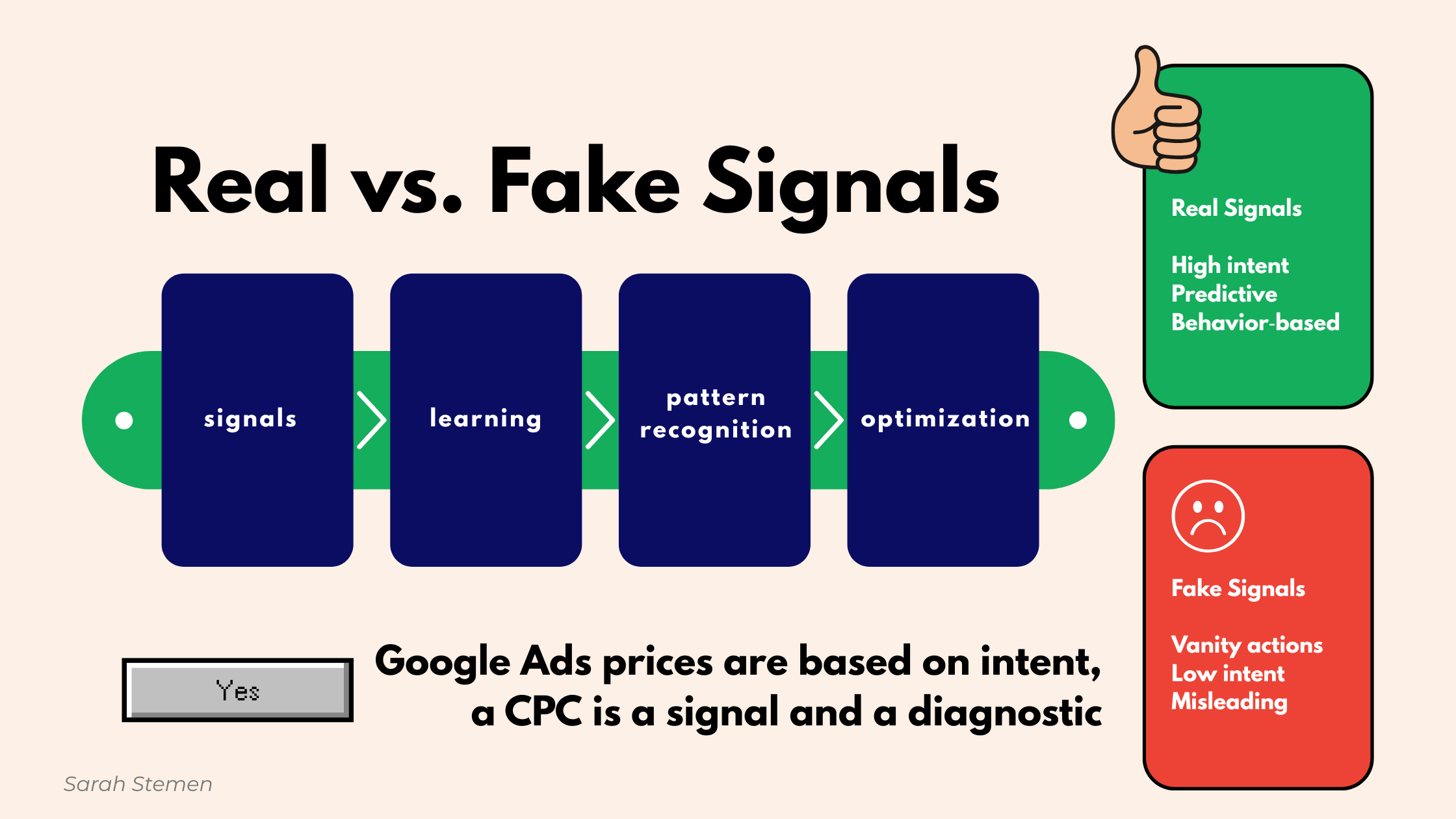
Real signals reflect intent. Fake signals reflect noise. Knowing the difference protects your budget and improves Google’s learning.
A universal diagnostic guide that helps you distinguish meaningful signals from noise.
In my consulting I warn clients that many “bad signals” aren’t actually bad — they’re just being misinterpreted because of last‑click distortion, which I break down in my Attribution Illusion post.
How do I know if my signals are actually helping my campaign?
This guide breaks down the difference between real intent signals and vanity signals — and how to diagnose signal quality in under 10 minutes.
Read the full guide → coming the third week of Jan 2026
8. How to Improve Google Ads Targeting (The Real Way)
A diagnostic guide to the three targeting layers Google actually uses — keywords, ads, and landing page signals — and how to fix misalignment so Google learns from the right data.
How do you improve Google Ads targeting? By tightening your Alignment Chain. Targeting isn’t a setting — it’s a sequence. When your keywords, ads, landing page, and signals align, Google automatically finds better-fit clients instead of cheap clicks.
Read the full guide → How to Improve Google Ads Targeting (The Real Way)
Sources I Monitor
To ensure accuracy, context, and real‑world relevance, I regularly review:
Google Ads Help Center
Google Ads Developer Documentation
Google Ads Announcements & Release Notes
PPC Chat conversations and community insights
PSA webinars and industry discussions
Search Engine Land (where I contribute analysis)
Actual client accounts and live campaign behavior
This hub is intentionally short. Each link goes deeper. Together, these guides form a complete, diagnostic system for understanding how Google interprets behavior, value, and intent.