Google Ads News & Industry Updates Hub | Diagnostic Analysis for 2026
Updated: January 20, 2026
Q1 2026 Executive Summary: The Diagnostic View
The start of 2026 marks a shift from Automation to Agency. In the dynamic world of paid search and marketing, adaptability is essential as ongoing changes continue to reshape strategies and outcomes. While the industry is focused on the “breaking news” of Google’s latest AI creative engines, the real diagnostic shifts are happening in the underlying plumbing:
Modular Control: The return of selectable placements (like Google Maps in Demand Gen) signals that "Black Box" advertising is hitting its limit for local businesses.
Journey-Aware Bidding: Google is moving away from final-click optimization toward a predictive model that values the path a client takes. My early take: This is Google’s attempt to 'read the room' by looking at secondary actions (like a therapist's 'About Me' page view) before the final booking.
Agentic Support: The rollout of "Ads Advisor" means businesses now have an AI interface to navigate, requiring a new level of diagnostic skepticism to ensure brand-safety and budget pacing.
I don’t chase every headline. This hub reflects the updates I have mentally and strategically processed—the changes that actually move the needle for my clients.
For help navigating these changes I offer Google Ads coaching services. I can cover other platforms as well but Google Ads is my core focus.
The Diagnostic Timeline (Q1 2026)
| Update Name | Official Release | Sarah’s Diagnostic | Status |
|---|---|---|---|
| Maps in Demand Gen | Dec 23, 2025 | Jan 4, 2026 | STABLE |
| Nano Banana Pro | Nov 21, 2025 | Jan 11, 2026 | EVOLVING |
| Journey Aware Bidding | Nov 17, 2025 | In Process | PILOT |
| Ads Advisor (Agentic) | Dec 2025 | Jan 11, 2026 | CAUTION |
Note: "Sarah’s Diagnostic" dates reflect when the feature was verified in live client accounts and strategy was finalized.
You’ll notice my 'Diagnostic' date usually follows the official release by several weeks. This is intentional. I don’t report on features until I’ve seen them live in client accounts and can verify their behavior. I’m not here to give you the news; I’m here to give you the strategy.
This hub is a diagnostic map that explains what Google Ads’ latest changes actually mean for small business owners, therapists, and service providers — without hype, panic, or industry spin. This approach is particularly helpful for small business owners and service providers who need actionable insights to make informed decisions.
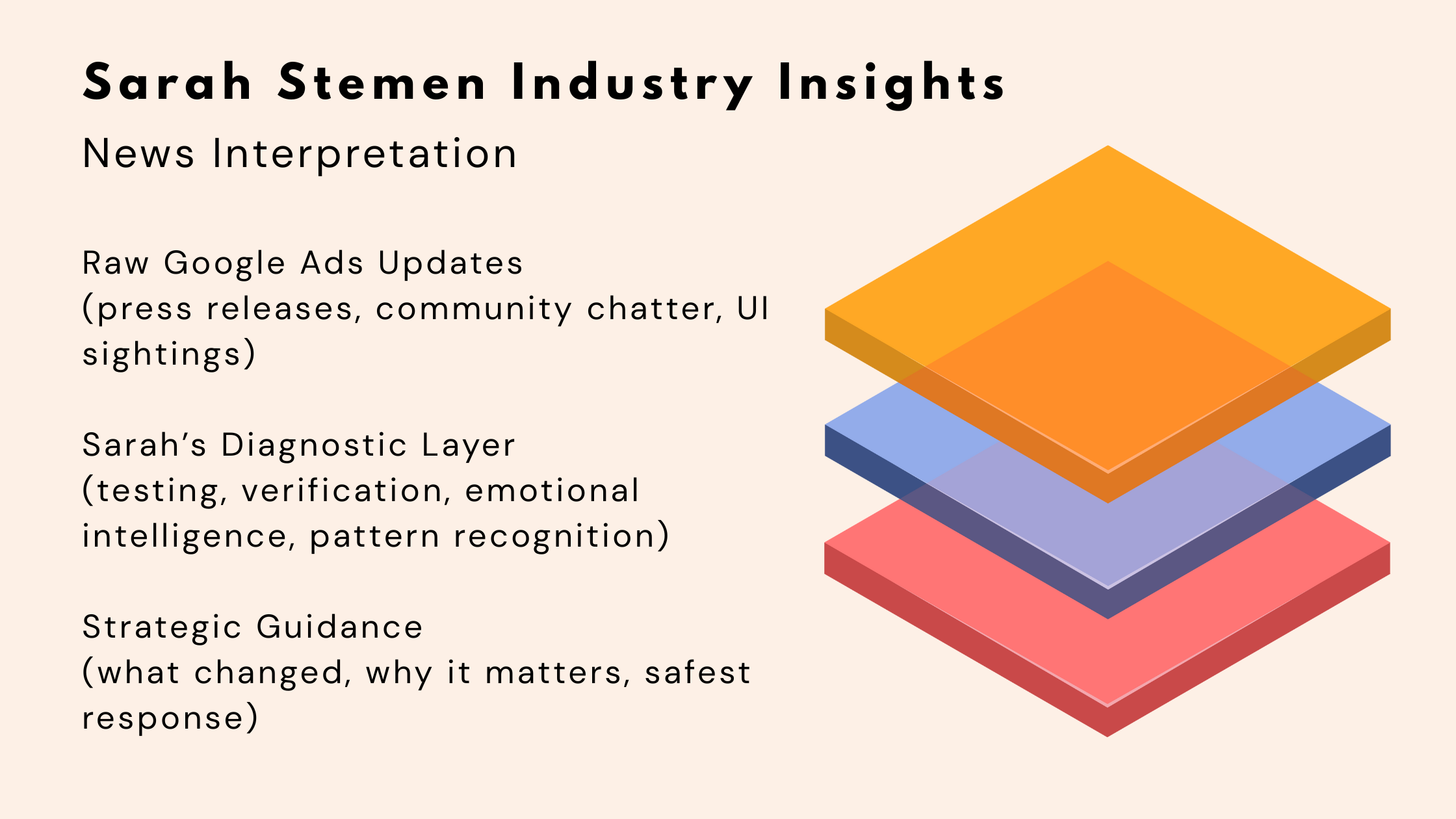
How raw Google Ads updates move through my diagnostic interpretation layer before becoming strategic guidance.
It covers Google Ads updates, structural changes, algorithmic shifts, and new features that influence performance, pacing, targeting, and strategy — all interpreted through a platform‑behavior lens.
This is not a news feed.
I’m not a reporter.
I source information from the Google Ads community.
This hub is written for small business owners, therapists, service providers, and anyone who needs clear, emotionally intelligent explanations of Google Ads changes without panic or confusion. I don’t publish every update Google releases.
I publish the updates I’ve already emotionally and mentally processed, tested, or analyzed — the Google Ads changes that reveal something meaningful about Google’s direction or your strategy.
This hub collects those updates in one place and links to deeper guides that break down:
the real symptoms
the real causes
the real strategic impact
and the safest way to respond
Use this hub as your interpretation layer — the place where raw Google Ads updates become clarity, context, and strategy.
If you want to understand how Google’s signal behavior fits into the broader patterns across Google, Bing, Reddit, and Meta, explore the Platform Behavior Hub.
If you need deeper strategy or want to understand how these updates affect real performance, explore these related hubs:
• Budget Pacing & Maximize Conversions (how Google spends your money)
• Audience Signals & High‑Value Signals (how Google interprets users)
• How Long Google Ads Takes to Work (learning phase + timelines)
How to use this Google Ads insights hub
Start with the update you’re hearing about, then follow the linked guide to understand:
what changed
why it matters
how it affects your campaigns
what (if anything) you should do next
This hub is your diagnostic navigation system — not a news ticker.
My approach blends platform‑behavior analysis, diagnostic interpretation, and emotionally intelligent strategy and not surface‑level reporting or recycled industry takes.
Note on Timelines:
I don't publish updates based on Google’s press release calendar. I publish my updates on a diagnostic timeline. You will see two dates here: when a feature was first spotted in the wild or talked about in the Google Ads community, and when I have finished testing it enough to offer you a "safest way to respond."
Why I created this
The PPC industry thrives on panic.
Every update becomes a crisis.
Every rollout becomes a “must‑change‑everything” moment.
Or a time for Google Ads experts to complain.
This hub is the opposite.
It’s a protective, emotionally intelligent system for people who want clarity — not hype, not fear‑based content, and not the industry’s favorite game of “Google changed something, so you need us.”
Selfishly, writing has pushed me to process Google Ads updates in a deeper manner.
That said…
I don’t chase headlines.
I don’t publish speculation.
I don’t amplify noise.
I publish the updates that matter — and I explain why they matter.
I ask a million questions about Google’s intent, the industry pressure, the economics, and the underlying mechanics.
I also do what I’m really good at: drawing parallels, naming patterns, and connecting dots.
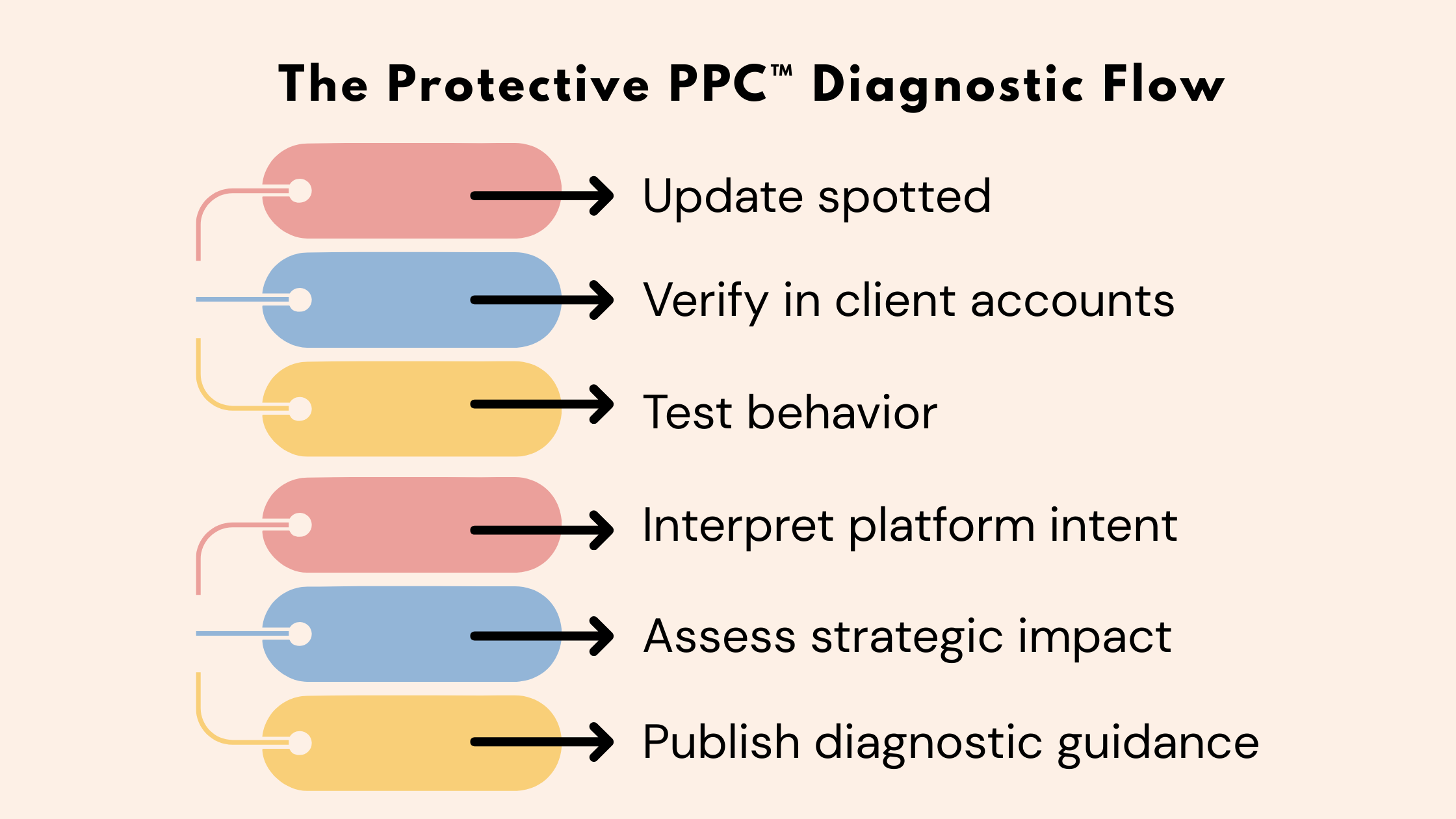
My Protective PPC™ diagnostic process — the steps I take before publishing any Google Ads update or strategic recommendation.
What’s included in this news and insights hub?
This hub brings together:
• processed Google Ads updates I’ve already analyzed
• structural changes that affect campaign behavior
• algorithmic shifts that influence bidding, pacing, and learning
• new features, experiments, and UI changes worth paying attention to
• deeper diagnostic guides that explain the real strategic impact
Recently Interpreted Updates from Google Ads
These aren’t “breaking news” items — they’re updates I’ve already processed, tested, or analyzed and turned into clear, diagnostic guidance.
Nano Banana Testing
Google’s new AI creative engine is appearing in select accounts.
I break down what it is, why it matters, and how it affects asset creation.
Google’s new AI creative engine (Nano Banana) is appearing in select accounts.
Diagnostic Note: Don't let the ease of creation lower your brand standards. AI assets often lack the 'emotional signal' required for high-trust niches like therapy which is an area I consult to often.
Read the post → I Beta-Tested Google’s New AI Creative Engine (Here’s What It Means for Your Q1 Strategy)
Maps Joins Demand Gen
A structural update that changes how local businesses show up in Google Maps.
I explain the strategic impact and why it matters for therapists and service providers.
Read the post → Google Maps Joins Demand Gen: Why This Update Changes Local Advertising in 2026
If you want to understand what this update means in practice, the next post in the series answers the real question: Should Local Businesses Start Using Demand Gen Now That Maps Is a Choice?
Campaign Total Budgets (The Architecture of Urgency)
A behavioral analysis of why Google introduced Campaign Total Budgets, how it shifts pacing from daily to flight‑based, and why this change moves Google Ads closer to an automated investment manager.
Read the post → The Architecture of Urgency: Decoding the Behavioral Motivations of Google Motivations of Google Ads Campaign Total Ads Campaign Total Budgets
Make sure you bookmark this page — I’ll add new items here as I process them.
Core Industry Guides
These aren’t updates — they’re foundational explanations that help you understand how Google Ads actually works beneath the surface.
How the 2026 PPC Landscape Has Changed (Introducing Protective PPC™)
A strategic breakdown of the three shifts redefining PPC in 2026 — automation drift, data loss, and rising CPCs — and the diagnostic framework I built to protect small businesses from these changes.
Understanding High‑Value Signals (A Diagnostic Framework)
This is not a Google announcement.
It’s a practitioner‑level guide that explains how Google interprets user behavior, intent, and conversion likelihood — and how to build signals that actually influence performance.
Read the full guide → What Are High-Value Signals in Google Ads?
The 2025 Google Ads Roadmap (What Google Announced for 2025)
A clear, accessible summary of Google’s official roadmap — the baseline context for everything Google planned before real‑world behavior shifts began.
Read the full roadmap summary → 6 Google Ads Updates from 2025 That Change Everything for Marketers
Shifts That Actually Change How Google Ads Works
These aren’t “big updates.”
They’re the shifts that actually change how Google Ads behaves, how campaigns learn, and how strategy needs to adapt.
I only include changes that reveal something meaningful about Google’s direction or the underlying mechanics of the system.
Demand Gen’s Expansion (And Why It’s Still Not Search)
What changed, what didn’t, and when Demand Gen is appropriate (and when it’s a budget trap).
Read the full guide → coming soon
Performance Max Transparency Updates
What’s real, what’s marketing, and how to interpret the new data without being misled.
Read the full guide → coming soon
Smart Bidding’s Behavior Shift
Why bidding feels more aggressive or unpredictable — and what’s actually happening under the hood.
Read the full guide → coming soon
Conversion Modeling Changes
Why your numbers look “off” and how to interpret modeled conversions correctly.
Read the full guide → coming soon
Policy Updates for Therapists & Sensitive Industries
What changed, what’s allowed, and how to stay compliant.
Read the full guide → coming soon
New & Emerging Google Ads Additions
These are early experiments, UI changes, or algorithmic behaviors I’ve caught and processed.
Nano Banana (Creative Engine Test)
I Beta-Tested Google’s New AI Creative Engine (Here’s What It Means for Your Q1 Strategy)
Journey Aware Bidding
A new predictive bidding model that uses behavioral sequences and secondary actions.
Read the full guide → coming soon
Agentic Support
Google’s new help and support functionality
Read the full guide → What Is Google Ads Advisor? How to Use It Safely (A Google Ads Coach’s Guide for Small Businesses)
E-commerce and Shopping Ads: 2026 Diagnostic Trends & Updates
The e-commerce landscape in 2026 is more dynamic than ever, with Google Ads and Google Merchant Center at the heart of how brands connect with shoppers in a rapidly evolving digital world. As online shopping continues to surge, Google is rolling out a series of updates and features designed to give merchants more control, flexibility, and actionable insights—helping them not just keep up, but get ahead.
User experience and ad relevance are front and center. Google Ads is doubling down on making Shopping Ads more intuitive and engaging, ensuring that users discover products that truly match their intent. With enhancements to broad match and campaign types, advertisers now have more ways to reach interested audiences, test new strategies, and optimize for performance across Google Search, YouTube, and beyond.
Demand Gen campaigns are taking the spotlight as a growth engine for e-commerce brands. These campaigns are now more versatile, allowing merchants to create compelling videos, run targeted promotions, and highlight products in new, visually rich formats. The integration of creative assets—like high-quality images, customer reviews, and dynamic promotions—means Shopping Ads can stand out in a crowded marketplace and drive more sales.
Smart Bidding strategies are evolving to offer both transparency and more control. Whether your goal is to maximize conversions, boost revenue, or manage spend, the latest smart bidding models use advanced AI and first-party data to align with your business objectives. Google is also providing clearer insights into how your bids are set and how your budget is being allocated, so you can make informed decisions and adjust your campaigns with confidence.
Google Merchant Center is getting a major usability upgrade. Onboarding is now smoother for new merchants, with streamlined product feed creation and enhanced performance analytics. The link between Google Ads and Merchant Center is stronger than ever, making it easier to manage your inventory, monitor campaign results, and discover new ways to optimize your listings for better visibility and sales.
First-party data is emerging as a crucial differentiator. Merchants who invest in building direct relationships with their customers—collecting and leveraging their own data—are able to create more personalized, relevant shopping experiences. This not only improves ad performance but also builds long-term loyalty in a world where privacy and data ownership matter more than ever.
YouTube is fast becoming a must-have channel for e-commerce advertisers. Brands are using video to showcase products, tell their story, and connect with audiences in authentic, memorable ways. With new placements and creative options, YouTube Ads are driving both awareness and direct sales, making it a key part of any modern e-commerce strategy.
Google is also investing in education and support. Free resources, webinars, and workshops are available to help merchants discover new features, learn best practices, and get the most out of their campaigns. Feedback from advertisers is actively shaping future updates, ensuring that Google Ads and Merchant Center continue to meet the real-world needs of retailers and brands.
Looking ahead, the pace of innovation isn’t slowing down. Expect new features, expanded reach into emerging markets, and even more ways to combine Google Ads with other marketing channels like social media and email. Subscriptions, creative upgrade options, and advanced analytics are all on the horizon, giving merchants more flexibility and control than ever before.
This hub is intentionally short.
Each link goes deeper.
Together, they form a complete, emotionally intelligent Google Ads update system — one that protects your strategy, filters out noise, and helps you understand what actually matters if you are running Google Ads or are considering running ads for your business.
Sources I Monitor
To ensure accuracy, context, and real‑world relevance, I regularly review:
• Google Ads Help Center
• Google Ads Developer Documentation
• Google Ads Announcements & Release Notes
• PPCChat Member conversations and community insights
• Paid Search Association (President) webinars and industry discussions
• Search Engine Land (where I contribute analysis)
• Search Engine Journal (where I contribute analysis)
• Actual client accounts and live campaign behavior
This hub will evolve as I publish new diagnostic posts.
I’ll add only the updates worth understanding — never the ones designed to create panic or clicks.
If you’re seeing a behavior in your account that isn't covered here, search 'Sarah Stemen + [Update Name]'—I likely have a diagnostic in the works.