The Google Ads Cost & Minimum Budget Hub
Updated: January 30, 2026
This blog post serves as a clear, diagnostic map that explains why Google Ads costs vary so widely, why small budgets struggle, how to calculate your minimum viable budget, and how to stop wasting money on campaigns that never had enough data to work in the first place.
It covers minimum viable budgets, CPC and intent, smart bidding data requirements, pacing behavior, rising costs, and the math behind why small budgets struggle.
It organizes the core cost concepts advertisers must understand — CPC, conversion rate, search volume, bidding strategy, pacing, and the Rule of 100 Clicks — and links to deeper guides for each topic.
Who this hub is for
This hub is written for small business owners, therapists, service providers, and anyone who needs a clear, emotionally intelligent explanation of how Google Ads budgets actually work.
What this Google Ads budget hub covers
• Minimum viable budgets
• CPC and intent
• Smart bidding and data requirements
• Budget pacing
• Rising Google Ads costs
• The Rule of 100 Clicks
• How to diagnose whether budget is the real problem
How to use this hub:
Start with the symptom you’re experiencing, or the question you have about Google Ads budgets then follow the guide linked in that section to diagnose the real cause.
Why I created this:
My approach blends platform‑behavior analysis, diagnostic math, and emotionally intelligent strategy and not generic “raise your budget” advice or recycled PPC talking points.
This budget pacing hub is a protective, diagnostic navigation map for small business owners, therapists, and service providers who want clarity — not hype, not fear‑based upsells, and not the industry’s favorite lie: “Just raise your budget.”
Google Ads costs feel chaotic because most advertisers never learn the math behind budgets, intent, and conversion probability.
And often, what looks like a ‘budget problem’ is actually a targeting problem — unclear signals, broad match chaos, or misaligned intent. If you need help diagnosing that side of the equation, start with my guide on improving Google Ads targeting.
An important warning is that in many accounts, the chaos isn’t coming from budgets at all — it’s coming from last‑click attribution, which hides the early‑stage campaigns that actually create demand. If your numbers look wrong, start with my guide on the Last‑Click Attribution Illusion.
This hub organizes everything you need to understand about cost and minimum budgets without manipulation, sales tactics, or PPC industry noise.
Each section links to a deeper, practitioner‑level guide that explains the real symptoms, the real causes, and the real fixes.
Use this hub as your starting point, your reference point, and your diagnostic map.
If you want to understand how Google’s signal behavior fits into the broader patterns across Google, Bing, Reddit, and Meta, explore the Platform Behavior Hub.
If you need deeper strategy beyond budgets, explore these related hubs:
• Google Ads News & Updates (structural changes that affect cost)
• Audience Signals & High‑Value Signals (how Google interprets users)
• How Long Google Ads Takes to Work (learning phase + timelines)
What’s included in this hub
This hub brings together:
• minimum viable budget math
• CPC, intent, and cost‑intent strategy
• smart bidding data requirements
• pacing behavior and overspend mechanics
• diagnostic principles like the Rule of 100 Clicks
• deeper guides that explain the real causes behind rising costs
1. Is $20 A Day Enough for Google Ads? (Start Here)
Start here if you’re running a small budget and wondering why results are inconsistent or nonexistent.
Why do small budgets struggle so much?
Most small budgets fail because they can’t generate enough clicks to reach statistical significance. This guide explains the math behind minimum budgets and why $20 a day is often too small for competitive industries.
Read the full guide → Is $20 a Day Enough for Google Ads? The Truth About Small Budgets
2. How Much Should You Actually Spend on Google Ads?
A clear, math‑driven explanation of how to calculate your minimum viable budget based on CPC, conversion rate, and your industry’s search intent.
How do I know what my minimum budget should be?
This guide walks through the numbers behind budget planning so you can set a spend level that actually gives Google enough data to work with.
Read the full guide → How Much Should You Actually Spend On Google Ads
4. Google Ad Daily Budget: How Much Should You Really Spend Each Day?
This is your practical handbook for the Google Ads interface. It explains exactly what happens when you type a number into that "Daily Budget" box and how Google actually spends it.
What number do I actually type into the daily budget field? This guide breaks down platform behavior—like the 30.4 multiplier and the 2x overdelivery rule—to ensure your campaigns have enough daily oxygen to exit the learning phase.
Read the full guide → Google Ad Daily Budget: How Much Should You Really Spend Each Day?
5. The Reverse Budget Formula (My Signature Math)
Your diagnostic method for calculating the minimum viable budget using CPC, conversion rate, and the Rule of 100 Clicks.
Why does my budget feel too small?
Most advertisers don’t have a “bad campaign” — they have a budget that can’t produce enough clicks to generate conversions. This guide shows you how to calculate the minimum spend required for your campaign to function.
Read the full guide → How to Calculate Your Google Ads Daily Budget: The "Reverse-Budget" Formula
6. Why Google Ads Costs Are Rising (And What to Do About It)
A clear explanation of auction pressure, competition, automation, and why CPCs increase even when your ads are “good.”
Why are my costs going up even though nothing changed?
This guide breaks down the real reasons behind rising CPCs and how to protect your budget without panicking or overreacting.
Read the full guide → coming the first week of Jan 2026
7. The Rule of 100 Clicks (And Why Impatience Kills Campaigns)
Your diagnostic principle for evaluating campaigns based on data volume, not emotion.
How long should I wait before judging performance?
Most campaigns need at least 100 clicks to produce meaningful data. This guide explains why impatience leads to bad decisions and how to evaluate performance correctly.
Read the full guide → The Rule of 100 Clicks: Why Your Google Ads Team Must Resist Impatience
8. Why Your CPC Is High (And What It Actually Means)
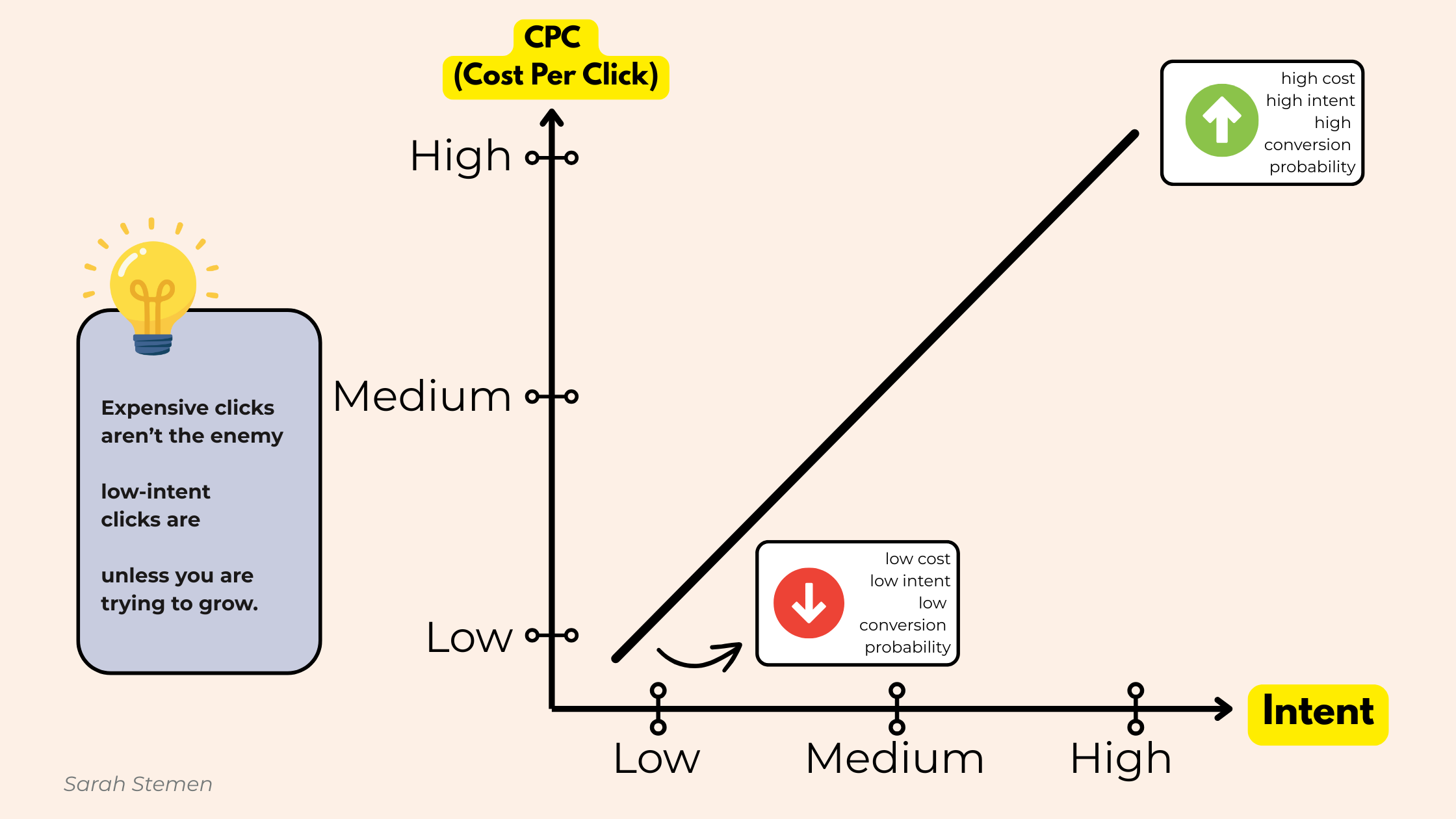
High‑intent keywords cost more because they convert more. Low‑intent keywords are cheaper but are harder to predict because they build “awareness” if they are used deliberately.
High CPC isn’t always a problem — sometimes it’s a signal of high intent.
Why are my clicks so expensive?
This guide explains the difference between expensive clicks that convert and cheap clicks that waste money, and how to diagnose which one you’re getting.
Read the full guide → coming the second week of Jan 2026
9. How Search Intent Impacts Cost
Not all clicks are equal.
Some industries pay more because their intent is higher.
Why do some keywords cost $2 and others cost $20?
This guide explains how intent, competition, and conversion value shape CPC — and how to choose keywords that match your goals and budget.
Read the full guide → coming the third week of Jan 2026
10. Why Smart Bidding Needs Enough Budget to Work
Smart bidding isn’t magic — it’s math.
And it needs data.
Why does my campaign perform worse on a small budget?
This guide explains why smart bidding struggles when budgets are too small and how to structure campaigns to give Google enough data to optimize.
Deep Dive: Maximize Conversions vs. Value: Why Their Budget Pacing Behaves So Differently — Learn the difference between the "Sprinter" and "Sniper" bidding mentalities.
11. How to Reduce Google Ads Costs Without Killing Volume
A practical, protective guide to lowering costs without sabotaging your campaign.
How do I lower my CPC without breaking my campaign?
This guide shows how to reduce costs through intent alignment, keyword refinement, and signal clarity — not hacks or shortcuts.
Read the full guide → coming the third week of Jan 2026
12. Why Your Google Ads Budget Explodes With Maximize Conversions (And How to Control It)
Maximize Conversions isn’t reckless — it’s obedient. Its job is to spend your full daily budget to get the highest number of conversions today, even if that means front‑loading spend, bidding aggressively, and legally spending up to 2× your daily budget.
Why does my budget suddenly spike after switching to Maximize Conversions? Because without a Target CPA or CPC guardrails, Google assumes volume is your only priority. This guide explains why Maximize Conversions behaves this way, how pacing works during the learning phase, and the guardrails that protect your budget without suffocating performance.
Read the full guide → Why Your Google Ads Budget Explodes With Maximize Conversions (And How to Control It)
Read the Comparison: Maximize Conversions vs. Maximize Conversion Value — A detailed look at why "Value" bidding is much more conservative (and selective) with your daily spend.
13. How Campaign Total Budgets Change Google’s Pacing, Costs, and Auction Behavior
Campaign Total Budgets remove daily caps, shift pacing from daily to flight‑based, and give Google significantly more freedom to front‑load spend. This guide explains why this change increases CPCs, accelerates cannibalization, and moves Google Ads closer to a predictive investment‑style system.
Why does my campaign behave differently with a Total Budget? Because Google is no longer optimizing for daily pacing — it’s optimizing for full‑flight spend and predicted conversion value. This creates new risks for small budgets and evergreen campaigns.
Read the full guide → The Architecture of Urgency: Decoding the Behavioral Motivations of Google Ads Campaign Total Budgets
14. Why “Cheap Clicks” Are a Trap
Low CPC is not the goal.
Qualified CPC is.
Why do cheap clicks never convert?
This guide explains why low‑intent keywords, broad match chaos, and symptom‑based queries lead to cheap but useless traffic.
Read the full guide → coming the third week of Jan 2026
15. How to Diagnose Whether Your Budget Is the Problem (Or Your Campaign Is)
Sometimes the budget is too small.
Sometimes the campaign is misaligned.
Sometimes it’s both.
How do I know what’s actually wrong?
This guide helps you separate budget issues from strategy issues so you can fix the right problem.
Read the full guide → coming the third week of Jan 2026
Sources I Monitor
To ensure accuracy, context, and real‑world relevance, I regularly review:
• Google Ads Help Center
• Google Ads Developer Documentation
• Google Ads Announcements & Release Notes
• PPC Chat conversations and community insights
• PSA webinars and industry discussions
• Search Engine Land (where I contribute analysis)
• Actual client accounts and live campaign behavior
This hub is intentionally short.
Each link goes deeper.
Together, they form a complete, emotionally intelligent Google Ads cost system — one that protects your budget, clarifies your strategy, and helps you diagnose what’s actually happening inside your campaigns.