Google Ad Algorithm: What Actually Controls Your Results in 2026
You want to know how Google Ads work. Here it is: every time someone searches, Google runs an instant auction. Your account competes based on a score called Ad Rank. That score blends your bid, expected click-through rate, ad relevance, and landing page experience. The winner shows up. The loser pays nothing.
That’s the simple version. Now let’s talk about what actually matters.
Stop Looking for “The Secret” (And What This Article Will Actually Tell You)
The Google Ads algorithm is a black box. We don’t crack it. We don’t reverse-engineer it. Anyone telling you they’ve “hacked” the system is optimizing for views, not your P&L. Since roughly 2015, machine learning has processed billions of signal combinations per auction your device, location, time of day, past behavior, query patterns and no human fully understands the weights.
What I see in audits from 2023 through 2026 is consistent: most failing accounts followed “best practices” from YouTube tutorials or Skillshop certifications. The advice wasn’t wrong in a vacuum. It was wrong for that specific business, that conversion cycle, that budget.
Here’s what each ad auction actually does in milliseconds: evaluates the query and context, checks which ads are eligible, calculates Ad Rank for every contender, sets a real-time bid, chooses which creative variant to serve. This happens before the search results page finishes loading.
This article won’t give you a magic setting. It will explain how the Google Ads system makes decisions, where most accounts send the wrong signals, and how to work with the algorithm based on your own data, tolerance, and economics. If you want certainty, you’ll need a different article. If you want results, keep reading.
How the Google Ads Auction Really Works (Without the Fairy Dust)
Every time someone searches on Google or hits inventory through Performance Max and Demand Gen, an auction happens. Your ads compete against other ads in real time. The algorithm processes your bid strategy, budget, Quality Score components, conversion data, audience signals, device type, time of day, location, and any first-party data you’ve provided.
Ad Rank determines whether your ad shows and where. Think of it as a score combining your maximum bid, expected click-through rate, ad relevance, landing page quality, and the predicted impact of your ad extensions and ad formats. High Ad Rank wins visibility. But here’s what the surface-level content misses: the highest bidder doesn’t always win.
Consider two advertisers bidding on “emergency plumber near me” in March 2026. Advertiser A bids $50, has a 5/10 Quality Score, weak ad copy, and a slow landing page. Advertiser B bids $20, carries a 9/10 Quality Score, relevant responsive search ads, and a mobile-optimized page with clear calls to action. Advertiser B wins. The algorithm predicts B will deliver more value to the user—and rewards that prediction with position and lower cost per click.
Ad rank calculations now span beyond classic search campaigns. Performance Max bundles Search, YouTube, Display, Discover, and Maps into one campaign. The auction dynamics shift when you let PMax run unchecked because Google redistributes your high-intent search traffic to subsidize weaker placements. More on that later.
Bid Strategies: You’re Choosing an Algorithm, Not a Setting
Your bidding strategy is your contract with the Google Ads algorithm. It tells the system what to optimize for and how aggressive to be. This isn’t a dropdown menu. It’s a commitment.
Here’s what the prescriptive advice gets wrong: “Always use Target CPA” sounds clean but ignores reality. The right strategy depends on your data volume, sales cycle length, and tolerance for volatility. Every automated bidding mode—Maximize Clicks, Maximize Conversions, Target CPA, Target ROAS, Max Conversion Value—optimizes differently. Each can be right or catastrophically wrong depending on your stage.
What I see in 2026 is newer advertisers pushed straight into conversion-based Smart Bidding long before they hit meaningful conversion volume. Twenty to thirty conversions per month is the minimum for stable learning. Without that, the algorithm guesses—and often guesses poorly.
Traffic-Focused Bidding: When Volume Matters More Than Efficiency
Maximize Clicks and manual CPC still have a place. New accounts, research phases, small budgets buying data—these are discovery scenarios where cheap clicks are strategic.
Picture a B2B SaaS startup in Q1 2026 spending $30 per day. They’re not expecting profitable leads yet. They’re mapping search terms, building remarketing lists, understanding which queries bring engaged visitors. That’s a data buy, not a lead gen campaign.
Manual bidding or Enhanced CPC works for ultra-low volume, niche industries, or very long sales cycles where Smart Bidding lacks feedback. If your sales cycle is 90 days and you close three deals a month, the algorithm has almost nothing to learn from. Manual control keeps you from bleeding ad spend while waiting.
Conversion-Focused Bidding: When You Let the Algorithm Drive
Maximize Conversions and Target CPA bidding chase reported conversions within your budget or target cost per acquisition. They work when you have sufficient data—at least 20 to 30 conversions per campaign over 30 days.
Here’s the trap: using micro-conversions like add-to-cart events, lead form steps, or 50% scroll depth can help early learning. But optimizing to weak signals often destroys lead quality. The algorithm delivers what you ask for. If you ask for cheap clicks that scroll halfway down a page, you’ll get them.
What I see in audits is Target CPA turned on with 3 conversions in the last month and everyone blaming the algorithm, not the lack of signal. That’s not an algorithm failure. That’s signal poverty.
Revenue-Focused Bidding: When Profit, Not Just Conversions, Matters
Maximize Conversion Value and Target ROAS are the revenue-driven cousins of Target CPA. They’re ideal for eCommerce and businesses with high-variation deal sizes where not all conversions carry equal value.
These require accurate conversion value data and stable tracking setup. Common 2024–2026 issues with Google Analytics mismatches—GA4 reporting different values than Google Ads—create chaos. The algorithm optimizes precisely to the values you feed it. Over-report value by counting every lead as equal, and you’ll overbid on junk traffic.
Example: an online store in 2026 with an average order value of $120 sets a Target ROAS of 500%. After 60 to 90 days of stable data, they gradually tighten. That patience is required. Jumping to aggressive targets on day seven derails learning.
Quality Score: Why “Perfect” Can Still Lose You Money
Here’s a contrarian truth: having a 10/10 Quality Score on your favorite keyword can be financially worse than a 6/10 on a better-intent query.
Quality Score in 2026 still comprises three components: expected CTR, ad relevance, and landing page experience. Google uses these as proxies for user value. You’re rewarded with lower CPC for higher expected performance metrics. But only if the underlying intent is profitable for your business.
Consider a vanity term like “project management tools.” Great Quality Score. Huge volume. Terrible SQL and booking rates because the intent is broad and early-funnel. Compare that to a narrow, expensive term that closes at 25%. The 6/10 Quality Score keyword might generate ten times the lifetime value per click.
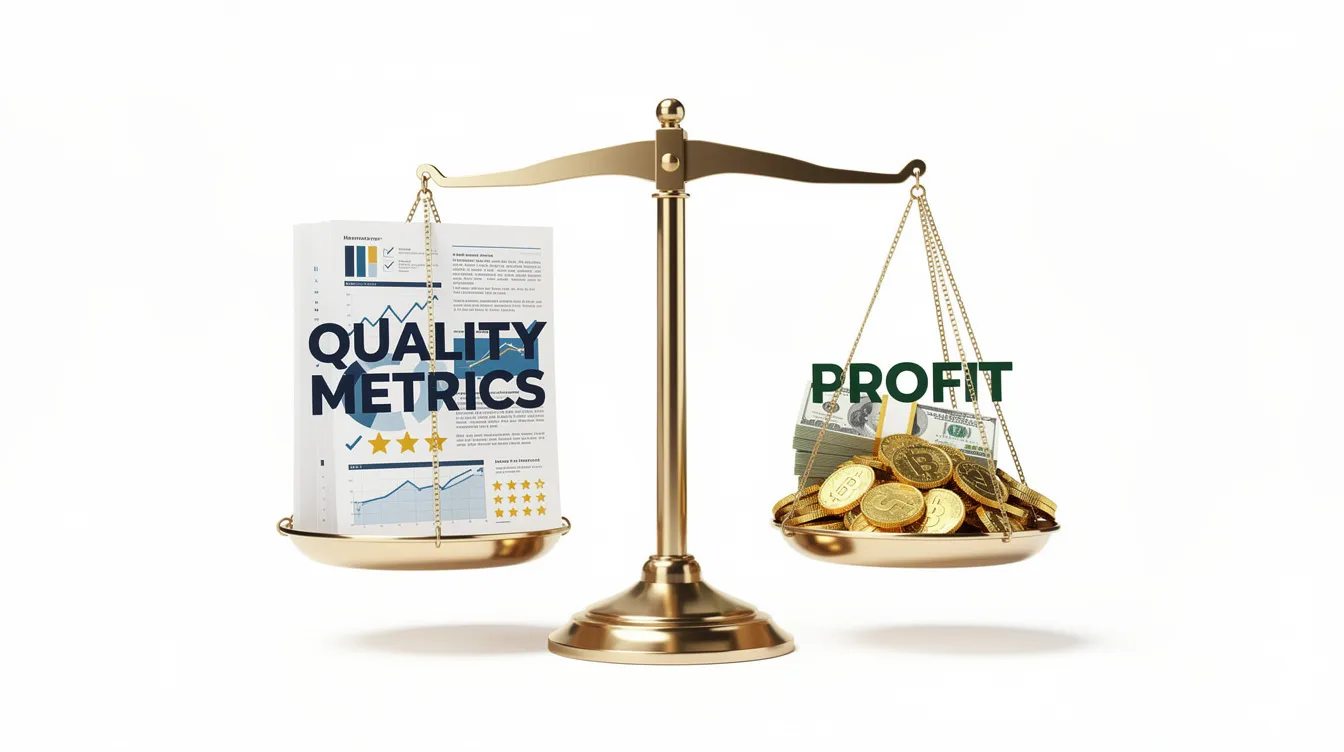
The image features a balance scale, with quality metrics such as landing page experience and ad relevance on one side, and profit represented by dollar signs on the other. This visual metaphor highlights the relationship between campaign performance in Google Ads and overall business objectives in digital marketing.
Optimizing for Quality Score alone is dogma. Optimizing for marginal profit per click is strategy.
Signal Architecture: What You Feed the Algorithm Is the Real “Hack”
Signal architecture means which data points you give Google—keywords, audiences, conversions, values—and how selective they are. In 2026, control has shifted from micromanaging bids and match types to designing clean, strong signals the system can trust.
Data over dogma. That’s the mantra.
Modern structures like AI Max, Performance Max, and broad match with Smart Bidding rely heavily on your signals. Sloppy conversion setups or mixed-intent campaigns confuse the algorithm. Garbage in, garbage out. High-signal in, selective outcomes.
The next sections show where most audits reveal signal problems: mixed conversions, brand versus non-brand mixing, and underused audience data.
Conversion Hygiene: Stop Telling Google That Every Click Is a Win
Every event you mark as a primary conversion becomes a target. Include weak actions—page views, newsletter signups, eBook downloads—and the algorithm optimizes for cheap but low-value interactions.
Differentiate primary conversions (sales, qualified leads, booked calls, phone calls) from secondary micro-conversions (page views, video plays, scroll depth). Use micro-conversions only as temporary training wheels on new accounts. Phase them out once real conversions hit 15 to 30 per month.
Audit insight: many 2024–2026 accounts show beautiful CPAs on “contact form starts” while actual SQLs fell off a cliff. The conversion rate looked healthy. The revenue didn’t.
Brand vs Non-Brand: One of the Easiest Ways to Mislead the Algorithm
Mixing brand and non-brand search terms in the same campaign gives Smart Bidding the wrong picture. Brand inflates conversion rate and compresses CPA. The algorithm thinks it’s winning when it’s just catching people who already know you.
Clear separation matters: dedicated campaigns for brand search, separate for non-brand, with distinct targets and budgets.
Example: a local service business in 2025 running one blended campaign thinks their $12 CPA is normal. An audit reveals non-brand actually sits at $110 CPA. The blended average hid a painful truth.
This separation also matters for PMax. Brand terms and existing customers can dominate multiple campaigns if not segmented and controlled, hiding non-incremental ad spend.
Audience Signals: Hints, Not Handcuffs
Audience signals in Performance Max and Demand Gen—customer lists, custom segments, in-market audiences—act as hints, not strict targeting fences. Google will still chase conversions wherever it finds them.
Don’t over-engineer dozens of tiny asset groups and audience segments. The algorithm expands from your seeds toward whoever converts.
Use first-party data—customer lists, high-value segments, recent converters—as strong positive signals to skew learning toward profitable users. Most audits find underused Customer Match and remarketing lists alongside overused generic interest audiences that add noise more than value.
Broad Match & Query Matching: Why 100% Relevance Is a Fantasy
Broad match in 2026 runs on semantic understanding, intent estimation, and cross-signal learning. It doesn’t match text literally. It matches meaning.
Set honest expectations: with broad match plus Smart Bidding, you will never get 100% relevant queries. An 80/20 relevance ratio can be very profitable if you manage negative keywords properly. The search terms report becomes your discipline tool.
Here’s what the YouTube video won’t tell you: you must be willing to burn budget on exploration. In many markets, $1,000 or more per month for 60 to 90 days before broad match stabilizes.
Contrast with exact match: tighter control, cleaner reports, but slower discovery and sometimes higher CPC for the same intent. Many losing accounts you audit either cut broad match after 7 days of “bad” queries or embraced it with zero negative keyword discipline.
AI Overviews and expanded search results now mandate broad match or PMax for full ad visibility. The old tight-control playbook is shrinking.
Performance Max: The Algorithm’s Playground (And Your Blind Spot)
PMax is not a campaign type. It’s a permission slip for Google’s algorithm to blend networks—Search, YouTube, Display, Discover, Maps—and chase your defined goal with minimal transparency.
The inputs PMax actually cares about: conversion tracking, conversion values, budgets, audience signals, creative assets, brand exclusions, and product feeds for shopping campaigns. Everything else is decoration.
PMax redistributes value. It uses profitable search inventory to subsidize weaker ad placements on Display and video ads because you can’t see or block most of it. The auction insights you’d get in standard search campaigns disappear.
Deploy PMax only after search campaigns have proven profitable and you understand your unit economics—maximum CPA, break-even ROAS. Otherwise you can’t judge whether PMax is helping or just recycling brand traffic.
In recent audits, PMax often over-credits brand search and retargeting, showing gorgeous ROAS while net-new acquisition stays flat.
Signals, Not Shiny Buttons: Setting PMax Up Like a Pro
Set up PMax with a small number of high-quality asset groups rather than dozens of untested variations. The algorithm needs density, not fragmentation.
Priority signals to include:
High-value customer lists (recent converters, repeat buyers)
Top-converting search themes from your existing Google Search Ads
Product feeds with accurate margins for shopping campaigns
Call assets and strong creative across ad formats
Example: a DTC brand in 2026 uses PMax only for remarketing and product expansion, leaving net-new search acquisition in standard search campaigns. They can measure incrementality because they control the split.
Don’t constantly tinker. The learning period takes roughly two weeks. Wait one full conversion cycle before judging changes. Mobile devices, desktop, different times—all need data before conclusions.
Smart Bidding’s “Learning” Period: What the Graphs Won’t Tell You
The visible “Learning” status in your Google Ads account is a simplified label. The underlying models continue to adapt indefinitely. Google states around 5 to 7 days and 50 conversions for initial learning, but real-world stabilization often takes a full 30 to 60 day conversion cycle.
In longer sales cycles—B2B SaaS with 30 to 90 day closes—algorithms heavily discount short-term noise. Patience isn’t optional.
Don’t react to 3 to 5 days of bad CPAs mid-learning by yanking budgets or targets. Wait at least one true conversion cycle. Every pause restarts learning. Every dramatic target change triggers recalibration.
Here’s what the YouTube video won’t tell you: your tolerance for short-term pain will decide if Smart Bidding ever has a chance to succeed.
Incrementality: The Metric the Algorithm Doesn’t Care About (But You Must)
Incrementality means new customers or sales you would not have gotten without the ads. Not conversions that would have happened anyway through brand recognition or organic search.
Google optimizes for reported conversions, not incremental ones. Brand search and retargeting inside PMax or AI Max often inflate reported ROAS because they capture people already on their way to buy.
Concrete example: a DTC brand in 2024 scales PMax, seeing ROAS jump from 300% to 800%. Post-purchase surveys and holdout tests show little new customer growth. The dashboard looked great. Revenue stayed flat.
Ways to approximate incrementality:
Geo-split tests (hold out regions, compare to controls)
Brand versus non-brand split reporting
Holdout groups for retargeting campaigns
Tracking new versus returning customers in Google Analytics
Many online “best practices” ignore incrementality entirely, leading to gorgeous dashboards but stagnant revenue curves.
Marginal CPA and ROAS: Where the Algorithm Quietly Overspends
Blended metrics hide the real cost of your last dollars spent. Your average CPA might be $60, but what’s the CPA on the final 30% of budget?
Smart Bidding will happily keep spending until the blended CPA meets your target, even if the marginal dollars are dramatically less efficient.
Simple example:
| Spend Tier | Spend | Conversions | CPA |
|---|---|---|---|
| First tier | $5,000 | 125 | $40 |
| Second tier | $3,000 | 32 | $94 |
| Blended Total | $8,000 | 157 | $51 |
That blended $51 masks severe overspending on the margin. Real audits in 2025 and 2026 regularly uncover this pattern, especially in accounts that auto-accept Google’s “raise budget” suggestions.
Use bid simulators, budget experiments, and manual analysis of campaign performance by spend bands. Find the sweet spot where marginal efficiency collapses.
Network Economics: How Google Redistributes Your Best Traffic
From 2021 to 2026, the bundling trend accelerated. Search plus Display plus YouTube plus Discover plus Maps, packed into mixed campaigns like PMax and Demand Gen. Search partners, display campaigns, video ads—all merged.
Surplus value from high-intent search queries gets used to prop up weaker, cheaper inventory where Google has more to sell. The platform has a financial incentive to keep you in bundled, opaque modes because they smooth auction pressure and increase fill rates.
Recent “improvements”—network breakdowns, brand controls, search terms visibility—often just restore transparency that used to be standard in pre-PMax search campaigns.
Start from pure search with separate campaigns per network where possible. Define business objectives clearly at the ad group level. Layer PMax intentionally once baselines are known, not before.
The Information Economy vs. Your Account Reality
Content creators get rewarded for confidence, novelty, and simplicity. Not for nuance, caveats, or “it depends.”
The incentives gap is real: advice that works well for audience growth—bold one-size-fits-all rules—fails in actual accounts with specific business models and constraints. Marketing teams follow YouTube channels. Campaign management suffers.
In recent years, most accounts I audit followed some version of “just use Broad + Target CPA” or “PMax everything” without economic checks. The playbooks weren’t wrong universally. They were wrong for that specific business.
Contrast prescriptive advice (“always do X”) with iterative strategy: test, measure, and adjust according to your own unit economics and tolerance for risk.
Data over dogma. Your account tells the truth if you’re willing to look.
The Audit: Where Algorithm Theory Meets Your P&L
A serious 2026 Google Ads audit examines: search terms, conversion setup, attribution settings, marginal performance, network splits, and value distribution across ad groups and campaigns.
I regularly see accounts “doing everything right” according to online playbooks but misaligned with their actual funnel length, budget constraints, and lead quality requirements. A new campaign launched by the book still fails when the economics don’t fit.
A good audit doesn’t start with toggling settings. It starts with clarifying:
Maximum profitable CPA
Realistic ROAS thresholds
Time-to-revenue by channel
Acceptable conversion volume at each cost tier
The real questions: Are we optimizing to the right conversions? Are we rewarding the right traffic? Are we overpaying at the margin?
If algorithm behavior is inferred rather than fully known, an experienced strategist reviewing your account isn’t a luxury. It’s the only way to validate whether the system is working for you or against you.
Risk, Tolerance, and Timelines: Your Real “Algorithm Strategy”
The “best strategy” is the strategy your business can actually tolerate: in terms of budget, volatility, and lead quality over a realistic time horizon.
Three profiles:
Low-budget local business: Manual CPC or Maximize Clicks to gather data. Don’t force automated bid strategies before conversion volume supports them. Focus on landing pages and call assets.
Mid-market B2B with 90-day sales cycle: Wait 60 to 90 days before judging Smart Bidding. Use enhanced conversions or offline conversion imports. Accept that short-term data means nothing.
High-volume eCommerce: Test Target ROAS post-60 days of stable data. Watch marginal returns at scale. Separate brand from non-brand ruthlessly.
Many failures come not from the wrong bid strategy, but from mismatched expectations—wanting stable CPAs in 10 days on a 60-day sales cycle.
Define tolerance bands before changing algorithms: acceptable CPA range, learning budget, maximum test duration. Your job isn’t to “beat” the algorithm. It’s to set terms it can work within that align with your economics and patience.
Putting It All Together: A 2026 Playbook That Respects the Algorithm (and Your Business)
The pieces fit together when you understand: auction mechanics determine ad visibility, bid strategies dictate optimization goals, signal design controls what the algorithm learns, network economics redistribute your best traffic, and incrementality separates real growth from recycled conversions.
There is no hidden hack. Only disciplined testing, clean data, and structures that let you see whether the algorithm is helping or hurting.
Treat every change—new bid strategy, PMax launch, broad match expansion—as an experiment tied to specific hypotheses and success metrics. Digital marketers who iterate beat those who copy.
A simple starting sequence:
Fix conversion tracking (primary versus secondary, accurate values)
Separate brand from non-brand in your Google Ads account
Choose stage-appropriate bidding based on conversion volume
Define audience signals carefully using first-party data
Expand cautiously into automation-heavy formats like PMax
If you want certainty, you’ll keep buying courses. If you want results, you watch your own data and adjust—even when it contradicts the latest “expert” video.