AI Isn’t the Disruptor. The Platforms Are.
AI isn’t disrupting advertising — the platforms are. Microsoft and Google are collapsing the funnel into a single upstream decision moment controlled by AI agents. This shift raises costs, eliminates first‑party data, and forces brands to compete on clarity, structure, and diagnosable value.
TL;DR
AI agents collapse the funnel into one decision moment
Platforms profit by moving upstream
CPC is shifting to CPA/CAR
First‑party data dies when transactions happen inside AI
Only brands with clear, structured, diagnosable value qualify
Measurement must shift to MMM and incrementality
Brand equity becomes irrational and essential
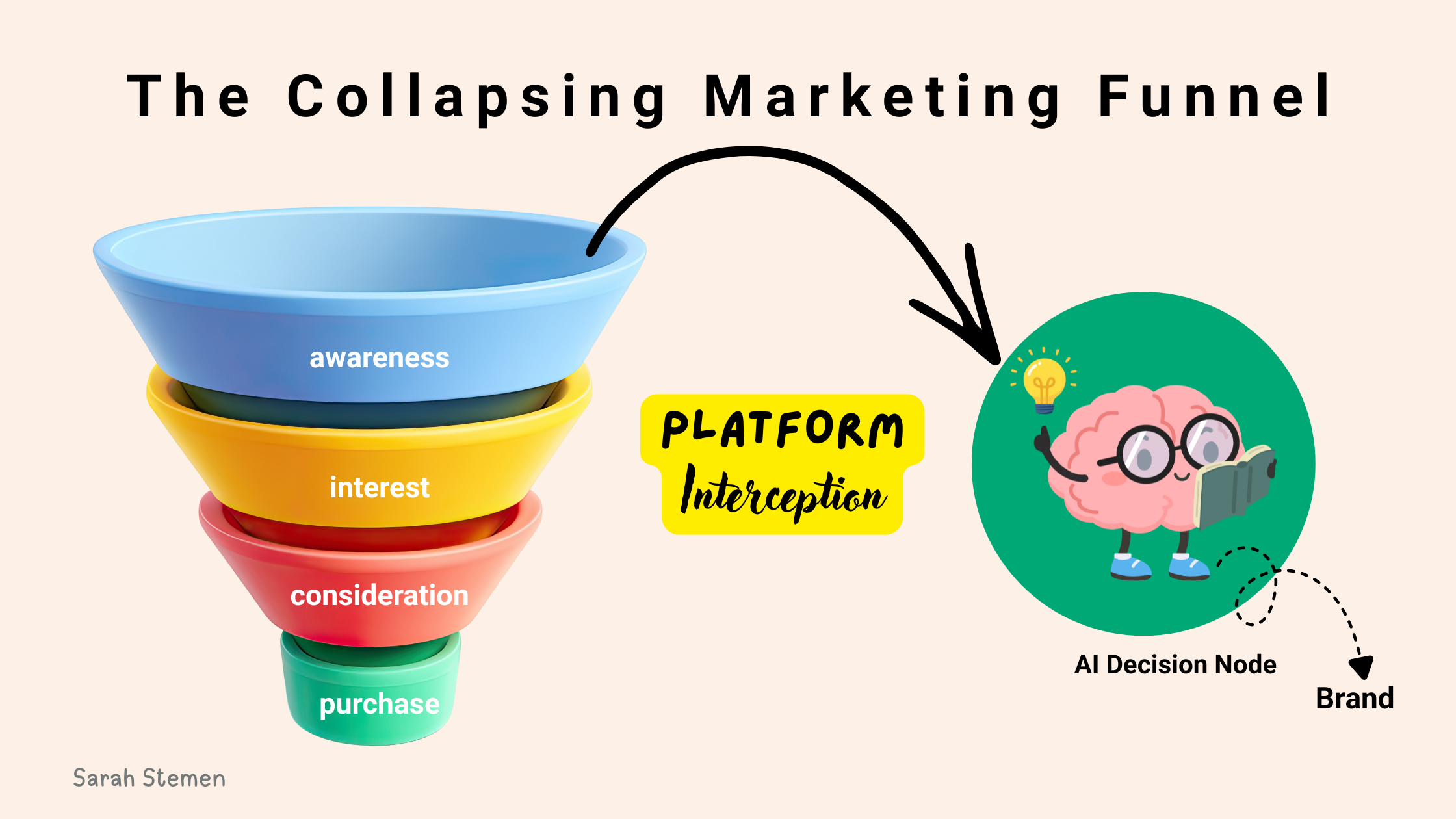
How AI agents collapse awareness, consideration, and purchase into one upstream decision moment — shifting power from brands to platforms.
I really don’t think most brands and advertisers are ready for what is going on in marketing in 2026. And I don’t say that lightly.
Both Microsoft and Google announced AI agents in their AI chatbots this past week. This post will focus on how AI agents inside chatbots impact the future of advertising.
What is happening with the platforms?
The ad platforms are actively collapsing the funnel so they can profit.
Most people who spend money on paid ads operate in a world where they are just following the data in front of them. This is how we have been taught to manage ads since the beginning of time.
Meanwhile while they are “optimizing the data”, the platform is actively moving upstream.
So when you are busy:
Adding negatives
Asking why your CPC has spiked
Wondering why ads are more expensive even though leads and sales are flat
The game is changing. And this is why you need to read this post today.
The Why: AI and Money (Big Money Stack)
AI is not helping by increasing sales.
It is not making life easier for businesses other than basic process improvement and pattern identification. In theory, that saves money, but not enough to justify the enormous cost of the tech.
Which I guess in theory saves money, but it doesn’t save enough to justify the enormous cost.
But it can take over the funnel.
AI uses patterns to move humans from awareness to consideration to purchase in one single moment. When you collapse the middle of the funnel, you are collapsing the decision layer.
That is where the money is.
The Impact: Costs are Going to Spike
Costs are going to skyrocket.
We are moving from "Cost Per Click" (CPC) to "Cost Per Recommendation" or "Cost Per Action."
Competition is going to intensify.
Because whoever shows up in that one AI-driven moment wins the sale, no one else ever enters the conversation.
This isn’t an upgrade in advertising this is a takeover.
When an AI agent handles the purchase, the ad platform can charge a commission or affiliate-style cut instead of a simple ad fee.
At that point, the platform stops acting like an advertising partner and starts behaving like a distributor or one that takes a direct bite out of business margins.
The Existential Risk: Are You Even Eligible?
Most businesses aren’t just "not ready" instead they aren’t even eligible to compete in this new environment.
AI does not reward:
The “best” product
The prettiest brand
The most heartfelt founder story
AI rewards:
Very specific clarity and structure
A diagnosable value
Crystal clear product data
Clean data feeds and information feeds
Messaging that compresses easily
If you cannot say who you are and who you serve in one sentence, you are cooked.
Your goal now is to appear in the citations and knowledge graphs that AI agents query before they make a recommendation.
You must influence the LLM’s training data and RAG (Retrieval-Augmented Generation) systems, or the AI will simply ignore you.
The Shift: AI Assistants Are the New Storefront
Your website is no longer the storefront; AI assistants are.
They are bypassing the website to make decisions inside the chatbot interface. The landing page is dying, and the transaction is moving into the AI itself.
Both Microsoft and Google noted in recent press releases that “the merchant remains the merchant of record.”
If you know how these announcements work, you know that phrase went through months of legal vetting.
The fact that they had to state it proves they are standing on the edge of fully disintermediating the brand.
If you want to see how Microsoft is already doing this with Copilot Checkout, I break it down in: Microsoft Announces Copilot Checkout and Brand Agents
The Death of First-Party Data
If the "transaction moves into the AI interface," the brand loses the most valuable asset of the last decade: customer data.
If the transaction happens inside the AI, you lose your most valuable asset: customer data.
If a user buys via a "Google Agent," Google or in Copilot then who owns the email, the behavior data, and the upsell opportunity.
This creates a "Signal Paradox": If you can’t collect first-party data or calculate LTV, your ad costs will skyrocket because you lack the signals needed for lower-cost bidding.
If you want to explore all the posts I have been writing about signals you might want to explore this hub: The Google Ads Signals and Value Hub
I break down how Microsoft Copilot is already shifting transactions upstream in Microsoft Announces Copilot Checkout and Brand Agents.
How can businesses win?
If you feel like you need to revisit everything you’ve been doing, you’re right. But there is hope.
Build "Irrational" Brand Equity: AI agents are utilitarian. They are great for buying commodities (batteries, detergent). They are less effective at selling "desire." You must force users to ask for you by name. It’s the difference between saying "Get me a cooler" and "Get me a Yeti."
Shift Your Measurement: Traditional tracking (UTMs, Cookies, Pixels) doesn’t work inside a closed AI loop. You must move to Marketing Mix Modeling (MMM) or Incrementality Testing.
Google released Meridian this past year for exactly this reason.
If you think that’s a coincidence, it’s not. The platforms are breaking the old measurement system and selling you the new one at the same time.
This is why I created the Platform Behavior Hub.
We are entering the era of the agent, I want make sure you aren't left out of the conversation.
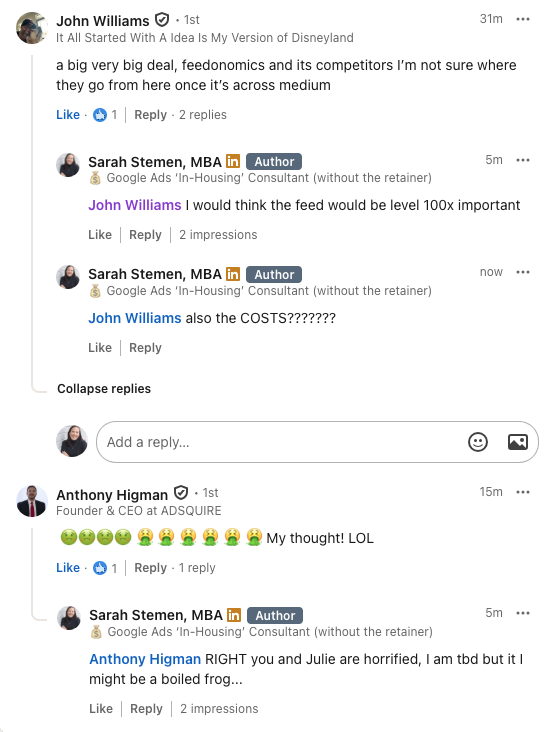
PPC Experts React to AI "I Shop For You" Agent Announcements
A LinkedIn discussion featuring Google Ads consultants and agency CEOs discussing the implications of AI shopping agents on the PPC industry. Key themes include the rising importance of product feed optimization, the uncertainty of advertising costs in an AI-driven ecosystem, and the potential disruption of traditional consumer search behavior. Insights from me (Sarah Stemen), Anthony Higman, and John Williams highlight the community's mix of skepticism and technical concern regarding AI-led commerce.
Key Takeaways
AI agents are not the disruptor — platform incentives are
The funnel is collapsing into a single upstream moment
Platforms will charge commissions, not clicks
Eligibility now depends on clarity, structure, and clean data
AI assistants are becoming the new storefront
First‑party data is at risk
MMM and incrementality replace traditional tracking
Brand equity must be strong enough to be requested by name
FAQs
What does it mean that platforms are collapsing the funnel?
It means AI agents compress awareness, consideration, and purchase into a single upstream decision moment — eliminating the traditional funnel.
Why will advertising costs increase in 2026?
Platforms will shift from CPC to commission‑based models as AI agents handle transactions inside the interface.
How can brands stay eligible in an AI‑driven environment?
By having clear, structured, diagnosable value and clean product or service data that AI can interpret.
Why is first‑party data at risk?
If transactions happen inside AI assistants, the platform — not the brand — owns the customer relationship.
What should businesses do next?
Invest in brand equity, restructure messaging for AI legibility, and adopt MMM or incrementality testing.