What Is The New Missed Opportunity Reporting In Google Ads
Google built Missed Opportunity Reporting because advertisers were losing trust in impression share as a growth signal. Impression share can be gamed — tighten match types, restrict geography, or narrow audiences, and your share looks higher even though your reach shrinks. That’s not what Google wants. They want advertisers to spend more intelligently, not manipulate metrics.
So this report reframes the conversation: Instead of “how much of the auction did you win,” it asks, “how much real demand did you leave on the table?”
It’s Google’s way of showing the economic cost of constraint — the conversions, clicks, and revenue you missed because your bids or budgets were too tight.
How to read it
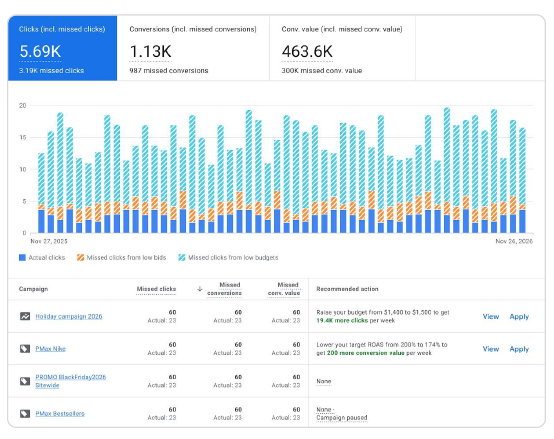
Each bar in the chart represents a day or week of campaign activity:
Blue bars = actual clicks (what you got).
Orange bars = missed clicks from low bids.
Light blue bars = missed clicks from low budgets.
The top summary boxes quantify the total missed clicks, conversions, and conversion value. The table below breaks it down by campaign and gives actionable recommendations — like “raise your budget” or “lower your ROAS target.” Those suggestions are algorithmically tied to auction data and seasonality, not arbitrary thresholds.
Google Ads Missed Opportunity Reporting - Announced at GML 2026
How to use it
Use this report as a diagnostic map, not a performance scorecard:
Spot patterns: Are missed clicks mostly from low bids or low budgets? That tells you whether your constraint is strategic or financial.
Prioritize campaigns: Focus on the ones with high missed conversion value — that’s where incremental spend could compound fastest.
Test Google’s recommendations: Treat them as hypotheses. Adjust gradually and measure lift in conversion value, not just clicks.
Why it’s actually a good idea
This is a step toward truthful opportunity modeling. Impression share rewarded control; missed opportunity reporting rewards learning and elasticity. It helps advertisers see the real headroom in their accounts — the part that’s invisible when you only look at what you already captured.
It’s not perfect, but it’s directionally smarter. It aligns with how predictive systems work: they need freedom to find value, not rigid match‑type fences.
Where Google’s Missed Opportunity Reporting Falls Short
⚠️ 1. It’s still reactive, not predictive
The report tells you what you missed, not what’s next.
It’s backward‑looking — a post‑mortem on lost potential — rather than a forward‑looking forecast of where demand is building. That means you’re always reacting to missed growth instead of proactively reallocating before it happens.
⚙️ 2. It assumes Google’s model of “value”
The conversion value estimates are based on Google’s internal auction data and modeled conversions. That’s fine for directional insight, but it doesn’t account for your actual business economics — margin, repeat rate, or lifetime value. So the “missed conversion value” might look impressive but could be misleading if those conversions aren’t profitable.
💸 3. It nudges spend, not efficiency
Every recommendation — “raise your budget,” “lower your ROAS target” — points toward loosening constraints. It’s designed to increase auction participation, not necessarily improve efficiency. For seasoned advertisers, that’s a subtle but important distinction: it’s a growth‑bias tool, not a profitability‑bias tool.
🔍 4. It doesn’t capture strategic intent
If you intentionally capped a campaign for testing or pacing reasons, the report will still flag it as “missed opportunity.” It can’t distinguish between smart restraint and unintentional limitation. That’s where human judgment still matters.
🧩 5. It’s portfolio‑wide but not context‑aware
Cross‑channel visibility is great, but it doesn’t yet integrate external signals — like inventory, seasonality, or creative fatigue. So while it shows where demand was left on the table, it doesn’t tell you why that demand wasn’t captured.
🧠 My Takeaway
This tool is useful as a diagnostic mirror, not a steering wheel. It helps you see where Google’s automation wanted more freedom — but it’s your job to decide whether that freedom aligns with your business reality.
It’s progress compared to impression share, but it still needs a strategist’s filter to turn “missed clicks” into meaningful decisions.