Stop blaming yourself for a "Black Box" you didn’t build.
Everyone in marketing wants your money.
The platform profits when you waste money. The agency profits when you spend it. You are the only one incentivized to save it.
I wrote this blog to expose the "Black Box" and show you how to protect your business. I don't sell management. I sell the solution you need to stop losing money on ads.
Search all blog posts:

"Limited by Budget" in Google Ads? Here's What I Tell My Clients
Are you seeing the “Limited By Budget” In Google Ads? This is meant to get your attention to encourage you to spend. These are the steps that I recommend to my clients who are bothered when they see the notification popping up in the platform.

Should My Business Actually Be Running Google Ads?
Most businesses jump into Google Ads because someone told them they should, a Google rep, an agency, a guru or even a friend. But the real question almost never gets asked: does Google Ads even make sense for your business?

What Is Modified Broad Match In Google Ads
If you’re still seeing +keywords in a Google Ads account, you’re not imagining it. Modified Broad Match was sunset years ago, but legacy data still lives inside old accounts. Here’s what it means today and how to clean it up without destroying your historical performance.
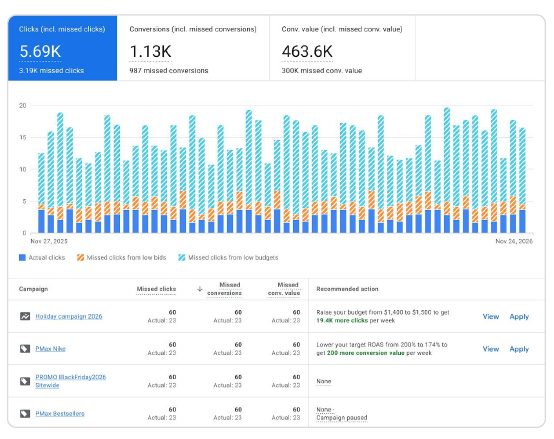
What Is The New Missed Opportunity Reporting In Google Ads
Missed Opportunity Reporting is Google’s attempt to replace impression share with a more honest view of lost demand. It’s useful, but not perfect. This post breaks down why Google built it, how to read it, and where it falls short — especially for advertisers who need profitability, not just more auction participation.

Google Ads Daily Spending Strategy: A Complete Guide to Strategic Budget Management
Most advertisers set a daily budget and hope for the best. I help you move beyond passive distribution to a deliberate spending framework. Learn how to implement strategic budget pacing and performance-based allocation that protects your margins and aligns every dollar with your actual business goals.

Smart Bidding in Google Ads: How to Use Google’s AI Without Losing Control
Is your Google Ads account ready for full automation? While Smart Bidding offers the power of auction-time signals and machine learning, it only works if your data density is high enough. This guide breaks down the four core strategies—from Target CPA to ROAS—and provides a pre-flight checklist to ensure you don’t lose control of your spend.

Google Ad Daily Budget: How Much Should You Really Spend Each Day?
What is a good Google Ads daily budget in 2026? Learn how to calculate your spend based on target CPA, CPC ranges, and the "30.4 rule." Avoid the learning limbo and find out why $10/day might be starving your success.
![Maximize Conversions vs. Value Bidding vs. Max Conversions: Budget Pacing Guide [Step-by-Step]](https://images.squarespace-cdn.com/content/v1/64d9f2d9944b8f367e803788/1769783808760-6EJKJGXE0S64A3BD3DWI/maximize-conversions-vs-maximize-conversion-value-cover.jpg)
Maximize Conversions vs. Value Bidding vs. Max Conversions: Budget Pacing Guide [Step-by-Step]
Why does one Google Ads campaign burn through budget by noon while another barely spends? The answer isn’t broken bidding, it’s the algorithm doing exactly what you told it to do. Here’s how to interpret pacing like a pro.

Mastering Google Ads Budget Pacing: Tips for Effective Spend Control
Budget pacing is the thing that keeps most PPC managers awake at night. After 17 years in the trenches, I’ve learned that the secret to scaling isn't just a better algorithm—it's the "mind-muscle connection" of knowing your numbers. From the brand-new 2026 Campaign Total Budgets to my manual tracking framework, here is how to stop reacting to spend and start leading your account.

Campaign Total Budget in Google Ads: The Hidden Behavioral Shift No One Is Talking About
Google Ads’ new Campaign Total Budgets look like a simple pacing update — but beneath the surface, they shift the entire auction into a predictive, investment‑style system. Here’s how this change impacts costs, cannibalization, and your evergreen campaigns.

Why Your Best Google Ads Are Being Disqualified (And How to Fix It)
Imagine a school principal deciding that only the anchor runner gets to go to the championship, while the rest of the relay team is kicked off because 'they didn't cross the finish line.' It sounds ridiculous, but it's exactly how most businesses run their Google Ads. Here is why chasing a single metric is erasing the marketing teammates doing the real work and how to fix it.

How Much Should I Spend on Google Ads? A Clear, Math‑Driven Budget Guide
If you’ve ever wondered how much you should actually spend on Google Ads, you’re not alone. In this guide, we walk through the real math behind minimum viable budgets — so you can stop guessing, understand your breakeven CPA, and set a spend level that actually gives Google enough data to perform.

Profit on Ad Spend (POAS): Profit‑Driven Advertising: ROAS vs POAS for Real Growth
Hitting your ROAS target doesn’t guarantee profit. This article breaks down why revenue‑based optimization can mislead your Google Ads strategy — and when profit‑based bidding actually makes sense.

The Google Ads Cost & Minimum Budget Hub
Google Ads costs feel chaotic until you understand the math behind CPC, intent, pacing, and minimum viable budgets. This hub gives you a clear, diagnostic map to stop wasting money and finally understand what your budget can — and can’t — do.

Google Ads Budget Optimization Strategies: Agency Red Flags and How to Protect Your P&L
Tired of Google Ads reports that show plenty of "activity" but no profit? Many agencies substitute genuine, analytical strategy for superficial account management, turning your ad budget into a silent P&L risk. Learn the three strategic alternatives a paid search expert uses to isolate profitable keywords, run high-impact tests, and stop budget leaks for good.

Google Ads Maximize Conversions Daily Budget Spending Strategy: Why Your Budget Explodes And How to Fix It
Switched to Maximize Conversions and your budget suddenly exploded? This post breaks down why Google spends so aggressively, what’s actually happening inside the algorithm, and the guardrails you need to protect your budget without killing performance.

Google Ads Budget Pacing: How to Control Spend, Protect Profit, and Stop Google From Spending Your Budget Early
Google Ads budgets aren’t daily caps…they’re averages. Google can spend up to 2× your daily budget, recalculate pacing mid‑month, and shift spend based on signals, constraints, and inventory. All of this causes anxiety.
This guide breaks down how budgets actually work, why pacing goes off the rails, and how to protect your money with better structure, better data, and smarter oversight.

How to Track Clients Leads in Honeybook with Google Analytics and Google Ads
Stop flying blind. Third-party CRMs are "walled gardens" that break standard conversion tracking. Learn how to bypass this limitation using Squarespace and the modern Google Tag to ensure every lead is counted in both Analytics and Ads.

Is $20 a Day Enough for Google Ads? The Truth About Small Budgets
Is your $20/day Google Ads budget working? If not, the problem isn't the size of your budget—it's the massive, invisible waste in your setup.
The reality is this: Most small accounts lose $100–$300 a month to 'Hidden Costs' like terrible Quality Scores, irrelevant clicks, and lazy negative keywords. That wasted $1,800 a year is guaranteed to continue.
My $750 Hidden Cost Protection Plan stops that waste immediately. This isn't an expense; it's a one-time investment that pays for itself in just a few months by simply recapturing the money you were already spending inefficiently. Stop paying the Google 'inefficiency tax,' and start building a profitable foundation today."