The Law of Diminishing Returns in Google Ads
If you run Google Ads campaigns spending five figures or more every month, you have likely noticed a puzzling pattern: as your monthly budget goes up, your cost per inquiry or CPA starts creeping up right along with it.
It feels completely backward. Some advertisers seem to believe that writing Google a bigger check puts them in a stronger position, as if spending more earns them a discount, special treatment, or better economics.
In almost every other business scenario, buying in volume gets you a bulk discount. Like Costco.
But Google Ads is not Costco.
With Google Ads search auctions, spending beyond a certain point almost always leads to diminishing returns. As budgets expand, you are forced to go after less efficient inventory, causing your cost per conversion to rise.
If your cost per acquisition is climbing while your ad spend expands, your account is actually operating exactly as search auction economics dictate. Here is why that happens, why agency incentive structures keep managers from fixing it, and how pulling back spend can restore your profitability.
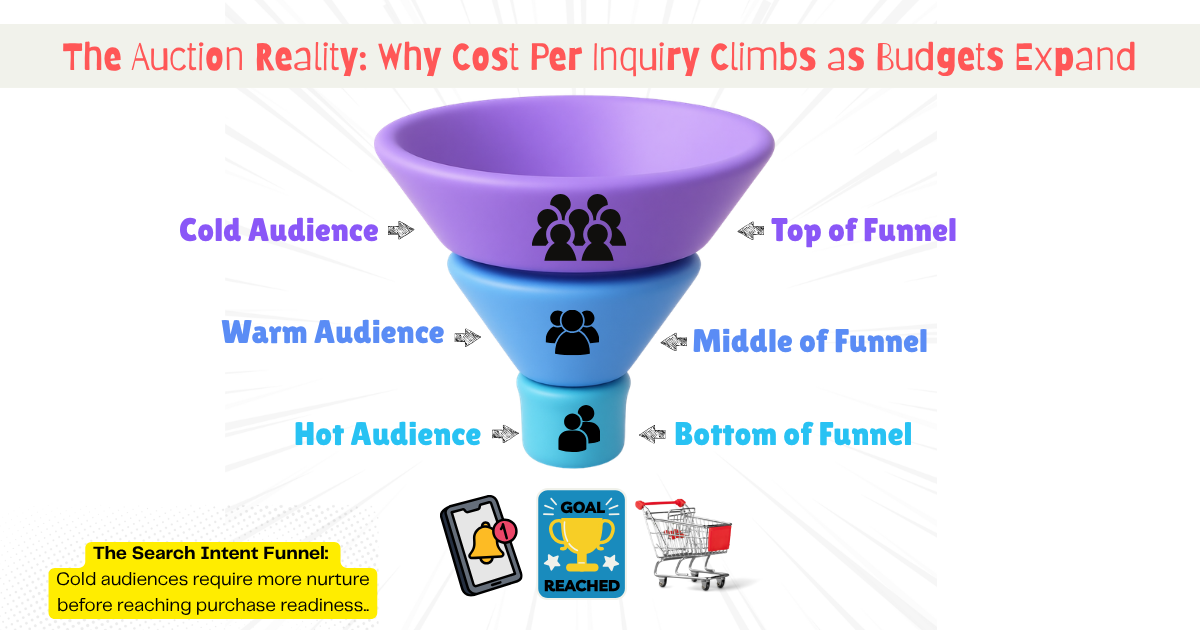
The Auction Reality: Why Cost Per Inquiry Climbs as Budgets Expand
The Auction Reality: Why Cost Per Inquiry Climbs as Budgets Expand
Google Ads operates on an auction system built around user search intent and prospect awareness.
When your budget is tightly focused, your campaigns target your highest intent searchers. These are hot prospects using exact match search terms, actively looking for specific solutions, and ready to convert immediately. Your cost per lead stays low because you are buying exclusively at the bottom of the funnel.
When you push a monthly budget into five figures, the platform needs new places to deploy those extra dollars. To spend that additional capital, your account has to expand into audiences that are fundamentally colder:
Lower Search Intent: Broad match types capture looser search queries from people who are researching rather than buying right now.
Colder Prospect Awareness: Upper funnel searchers do not know your brand yet, have not fully defined their problem, and require far more convincing before submitting an inquiry.
Increased Friction: Colder traffic requires more trust signals and multiple touchpoints to convert. It is not necessarily that cold traffic is too expensive to buy, it just takes longer to convert. If your landing page treats a cold researcher like a ready to buy shopper, your conversion rate drops sharply.
Higher Competitive Friction: Bidding aggressively in broader placements forces you into competitive auctions that push up your cost per click.
As you go after those marginal conversions from colder, more hesitant prospects, the total cost to acquire each additional lead goes up. Those expensive extra conversions pull your overall average cost per lead upward right along with them.
The Agency Incentive Conflict: Why Waste Trimming Gets Ignored
If pulling back budget lowers your cost per inquiry, why isn't every account manager suggesting it?
It comes down to financial incentives.
To be fair, it is not always a matter of bad intent.
Any experienced marketer knows that if you trim your spend down to harvest only bottom funnel, ready-to-buy traffic, your pipeline eventually dries up.
You need cold traffic entering the top of the funnel to build awareness, nurture future buyers, and keep your brand top of mind. Expanding into colder audiences is a necessary long term strategy for growth, even if it drives up your short term cost per inquiry.
The issue is that the financial structure of the agency relationship creates a natural conflict of interest.
The majority of search management partners structure their fees as a flat percentage of overall ad spend. If an account spends $30,000 a month, the management fee is tied directly to that $30,000. If an account manager trims that budget back to $15,000 to eliminate low performing keywords, cut out cold traffic leaks, and lower the cost per inquiry, their management fee drops immediately.
Even when an agency believes expanding into colder traffic is the right long term move, they are financially disincentivized from recommending a budget reduction. That gray area makes it hard for business owners to know whether budget expansion is serving strategic pipeline building or simply protecting agency retainer revenue.
True account efficiency requires balancing both worlds: nurturing cold traffic intentionally while ruthlessly trimming pure waste like bad search queries, mismatched intent, and broken match types that drag down profitability without building real future demand.
Spend Model vs Efficiency Model
| Feature | Percentage of Spend Fee Model | Protective Efficiency Model |
|---|---|---|
| Primary Focus | Maximizing Total Spend | Maximizing Account Profitability |
| Core Action | Expanding Budgets to Colder Audiences | Trimming Wasted Spend and Protecting Bottom Funnel Intent |
| Bottom Line Result | Higher Agency Revenue, Higher Cost Per Inquiry | Lower Ad Spend, Lower Cost Per Inquiry |
How to Pull Back Spend and Restore Account Efficiency
You do not need to keep burning capital to generate qualified leads. Taking control of your cost per inquiry starts with running three specific checks inside your account:
Audit Search Terms for High Cost Non Converters
Review your search terms report over the past 90 days. Filter for queries that have spent double your target cost per inquiry without producing a single lead. Add those terms as exact match negative keywords immediately to stop paying for cold, low intent traffic.
Separate Branded Search from Non Branded Campaigns
Ensure your brand keywords are not mixed into general acquisition campaigns. Branded search produces cheap conversions from hot traffic that mask the high cost of broader, colder search terms, giving you a false sense of overall account health.
Tighten Target Cost Per Acquisition Goals
If you run automated bidding strategies, lower your target cost per acquisition limits. This forces the bidding algorithm to compete only in auctions with a high probability of conversion, pulling back spend on cold searchers while keeping your most profitable conversions intact.
Scaling down ad spend to scale up account profitability is a proven approach. By trimming the excess, you force Google Ads to focus strictly on your highest converting searchers.
Final Thoughts
The goal of Google Ads is not to spend more money. The goal is to acquire profitable customers at a cost that makes sense for your business.
If your CPA keeps rising as your budget grows, the answer is not always better targeting, more automation, or another campaign. Sometimes the answer is simply recognizing that you've pushed beyond the most efficient part of the auction and are now paying increasingly higher prices for increasingly lower intent traffic.
That's where a second set of eyes can make all the difference.
I help business owners identify where diminishing returns are creeping into their accounts, uncover wasted spend hiding behind inflated budgets, and determine whether additional investment is actually creating growth or just producing more expensive leads.
If you're spending five figures a month on Google Ads and wondering whether your account is truly operating efficiently, schedule a coaching session with me. We'll review the data together and determine where your profitability is being gained, lost, or misunderstood.
More spend isn't always the answer. Sometimes protecting profit is.