The Anatomy of a Pattern-Interrupt: What AI Can’t Optimize for in Google Ads Copy
Generative AI is a master of the polished draft. You type a prompt into an LLM or use Google’s built-in asset generators, and a professional-sounding, grammatically flawless paragraph appears instantly.
I wrote about this from a personal angle when I was in Boston with no internet, writing in the hotel lobby.
That immediate response gives marketing teams a massive dopamine hit. It feels like efficiency. It looks clean.
The problem? Google Ads users (the people searching) don’t reward language that sounds "professional." They reward language that is disruptive, urgent, and psychologically sharp.
AI-generated copy is almost always strategically safe.
Because AI is trained on historical averages, AI optimizes for the absolute middle of the road.
It uses up your incredibly valuable, character-limited ad real estate without delivering a single ounce of uniqueness. Consumers can spot it from a mile away, and their brains are already trained to scroll past it.
If you want a safe, polite brand that blends seamlessly into the background of the Search Engine Results Page (SERP), let a machine write your ads.
But if you want to capture market share and attract high-value buyers instead of the wrong buyers, you have to inject human psychology.
The LinkedIn Teardown: A Masterclass in Human Positioning
To understand the difference between language that is simply "accurate" and language that actually converts, look at this real-world B2B ad run by LinkedIn.
LinkedIn specifically targeted users searching the web for alternative advertising channels though search which we call “conquesting ads”:
Conquesting ads or bidding on your competitor terms is historically hard to do because it requires having a lower quality score and essentially disrupting what the user (searcher is looking for at the time) with a unique ad.
Example Ad From LinkedIn
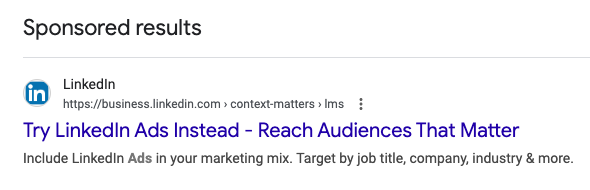
LinkedIn Ad Example
This is a wonderful example of a human written ad.
At first glance, it looks simple. But from a copywriter’s perspective, this is an elite psychological pattern-interrupt. An AI tool would never generate this ad, and here is exactly why:
The Challenging Phrase "Instead": A human copywriter understands the user's current intent ("I'm researching Reddit Ads"). By leading with "Instead of," the copy directly challenges the searcher's thought process and instantly presents an authoritative alternative.
The Emotional Weight of "That Matter": An AI focused purely on objective facts would output something sterile like, "Target highly-qualified professional audiences." A human strategist chooses "Reach Audiences That Matter" because it carries an emotional, aspirational punch. It also delivers a subtle, slightly funny competitive dig by implying that the other platform's audience doesn't matter.
The Conversational summary: Using an ampersand and an open-ended listing ("industry & more") mimics the natural cadence of a human expert giving a quick recommendation over coffee. It bypasses the stiff, exhaustive, bulleted lists that machines love to generate.
The Zero-Sum Prioritization Challenge
Writing responsive search ads isn't just a creative exercise; it is a high-stakes resource allocation challenge.
Google allows you to input up to 15 headlines, but the algorithm will only display a maximum of three to a user at any given time. Because you cannot control the exact combinations Google serves up without pinning, every single asset you input must be a heavy hitter.
When configuring your top three visible slots, a machine will routinely try to cram everything into a bland, generalized mush. A human-first strategy forces you to make a deliberate, difficult choice based on your current quarterly goals.
Are you prioritizing a Trust Signal, an Urgency Hook, or a Unique Value Proposition?
Look at the difference in those columns.
The AI variants look like standard ads; they are polite, and they are entirely uncompelling.
The human variants target an actual human emotion—the embarrassment of a hidden smile, or the sensory desire for cozy comfort. This brings humanity and who you are into your business.
| Value Angle | The Bland AI Variation (Safe & Forgettable) | The Strategic Human Overdrive (Psychological & Risky) |
|---|---|---|
| The Trust Signal | "Book a dental consultation today. Professional care." | “You Don’t Have To Smile With Your Lips Closed Anymore. Book Your Consult Today.” |
| The Comfort Hook | "Affordable HVAC Services Near You. Stay Cool All Summer." | “So Cool That You Curl Up Under A Cozy Blanket to Read A Book. Reclaim Your Cozy.” |
| The Urgency Factor | "Top-rated legal services available. Contact our team now." | “Don’t Wait Until the Audit Lands on Your Desk. Protect Your Assets Today.” |
The CMO’s Question: What’s the ROI of Generic?
As a Director of Marketing or an in-house PPC lead, you constantly have to justify your monthly ad spend to the C-suite. Your CMO isn't looking at your ad account asking if the headlines read smoothly. They are asking a much more aggressive question: "Did this ad justify its acquisition cost and contribute to our quarterly growth metrics?"
Generic, surface-level AI copy cannot confidently answer that question.
Safe copy generates generic clicks. In high-ticket verticals, those generic clicks quickly manifest as low-intent, incredibly expensive traffic that bounces straight off your landing page without converting into a qualified lead.
Running generic copy is a high-risk operational decision.
You are actively spending your company's capital to test messaging that you already know your closest competitors are generating with the exact same prompts. The five minutes your team saves by letting AI write the final product is instantly wiped out by the thousands of dollars lost running ads that fail to move the needle on revenue.
Move Beyond the AI Sea of Sameness
The real winners in the modern Google Ads landscape use AI to handle the baseline volume and overcome the blank page, but they rely entirely on experienced human oversight to apply the positioning that actually converts.
If you suspect your current paid ads marketing team is stuck in a creative rut and doesn’t give you enough attention, or that your vertical-specific agency is simply copy-pasting an AI-generated template across your account, your brand is likely paying an invisible tax on the SERP.
Stop running ads that blend into the background. Let's inject real psychology, brand authority, and strategic positioning back into your campaigns.
Ready for High-Performance PPC?
If you are a business owner, founder, or marketing director looking to actually on your Google ads account and stop jumping agencies. Talk to me, I work with you and create a custom, revenue-driven strategy. Let's look at your entire account ecosystem and see what we can do together.