Profit on Ad Spend (POAS): Profit‑Driven Advertising: ROAS vs POAS for Real Growth
Why would I choose profit‑based bidding over ROAS — and when shouldn’t I
Profit‑based bidding can align Google'’s optimization with your actual margins and bottom‑line goals, but it isn'’t always the right choice. POAS (profit based bidding) requires accurate cost data, a mental model shift, and ongoing reframing of ad performance. POAS is a just tool — not a replacement for ROAS — and it works best when you have reliable profit inputs and a clear reason to optimize for profit instead of revenue. Profit-based bidding ensures that advertising contributes positively to the company's bottom line, directly supporting overall business profitability. The real goal isn'’t choosing a metric; it'’s choosing the model that best reflects how your business makes money and aligns with business performance for long-term success.
You may have considered profit based bidding over ROAS as you wrestled with: The monthly budget review. You've hit your ROAS goal, but the finance department is still raising an eyebrow at the net profit numbers.
If the ads are working, why isn't the bottom line happier?
How this shows up — the questions and symptoms:
The Questions
Why isn’t a high Return on Ad Spend (ROAS) translating to higher profits for my business?
How can we shift from optimizing for revenue to optimizing for actual profit?
What is the fastest way to implement profit‑driven conversion tracking in Google Ads?
The Symptoms
“The ads are selling my cheapest products.”
“Maximizing conversion value is great, but my most expensive items cost the most to make and ship.”
The Illusion of Success: Why ROAS Can Be Misleading
On paper, everything looked great. Your Google Ads report showed strong numbers, your ROAS target was hit, and the performance summary looked like a win. But when you reviewed the quarterly financials, the profit wasn’t there.
This is the quiet trap many businesses fall into when they rely on ROAS as their main success metric. ROAS tells you how much revenue your ads generated — but it doesn't tell you whether that revenue actually made you money. It'n other words, ROAS measures revenue generated, not actual profit. It’s a helpful signal, but it'’s not the full picture. Profit is what reflects reality.
The most effective advertisers aren’t asking, “How much did we sell?” They’re asking, “How much did we keep — and what did it cost us to earn it?”
This shift from revenue to profit clarity isn'’t a small adjustment. POAS is a critical metric for businesses that want to measure success based on profitability, not just sales. It changes how you evaluate performance, how you allocate budget, and how you guide Google'’s bidding systems.
The ROAS Dilemma: When “Winning” Ads Quietly Lose Money
ROAS has a built‑in blind spot: it treats all revenue as equal, even when your profit margins are not. This is where businesses often get misled.
Here’s a simple example:
Product X: A $250 jacket with $100 in total costs → $150 profit
Product Y: A $40 hat with $35 in total costs → $5 profit
A campaign targeting a 400% ROAS sees these as the same outcome: $250 in revenue.
But the business impact couldn’t be more different:
One jacket sale = $150 profit
Six hat sales = $30 profit
Because hats convert more easily, Google may push them harder — not realizing they barely contribute to your bottom line. The system is doing exactly what you told it to do: maximize revenue, not profit.
This is how you can “hit your ROAS target” while quietly training the algorithm to prioritize your least profitable products.
If you want to see whether your ROAS is actually profitable — or quietly losing margin — run your numbers below with my free ROAS vs POAS calculator.
ROAS vs POAS Reality Checker
How Google Interprets “Maximize Conversion Value” + a ROAS Target
When you choose Maximize Conversion Value and add a ROAS target, Google is optimizing for revenue, not profit. ROAS is a revenue-based metric, which can mislead advertising campaigns by focusing on sales volume rather than actual profitability. A $250 jacket sale and six $40 hat sales look almost identical to the algorithm because they generate similar revenue — even though the profit difference is enormous. Since hats convert more easily, Google may push them harder to help you hit your ROAS target, even if they contribute very little to your bottom line. This approach can affect the overall effectiveness of advertising campaigns. The system is doing exactly what you told it to do: maximize revenue, not profit.
The Math Behind Google’s Decision
To Google, ROAS is simply revenue ÷ ad spend. Here, advertising spend is the key input, and the metric shows how much revenue is generated for each dollar spent on ad campaigns. So if your target ROAS is 400%, the system is trying to generate $4 in revenue for every $1 spent.
Here’s how that plays out:
Jacket example:
Revenue: $250
If Google spends $62.50 to get that sale → $250 ÷ $62.50 = 400% ROAS
In this ad campaign, you should evaluate the profit generated for each dollar spent on advertising.
Hat example:
Six hats = $240 revenue
If Google spends $60 to get those six sales → $240 ÷ $60 = 400% ROAS
Again, the ad campaign should be assessed based on the profit for every dollar spent on advertising.
To the algorithm, these outcomes are nearly identical. To your business, they are not:
Jacket profit: $150
Hat profit (six units): $30
This is why you can “hit your ROAS target” while quietly losing margin. The system is optimizing for revenue per dollar spent, not profit — because that'’s the data you gave it.
Before you choose ROAS or POAS, you need to know your real profit per product. Use the free calculator below to see how much you actually keep after each sale.
Profit Per Product Calculator
The Solution: Profit‑Driven Advertising (Not Just POAS)
The real fix isn’t switching to a new metric — it’s giving Google better data. When you assign profit instead of revenue as your conversion value, the algorithm finally understands what actually matters to your business. Supplying profit data provides valuable insights that enable more informed decisions about your advertising strategy.
Here’s how to approach it:
1. Calculate the True Value of a Conversion
For e‑commerce: Profit = Sale Price − COGS − Shipping Costs − Payment Fees A simple spreadsheet or ERP system can track this by SKU. Tracking average order value and leveraging e commerce analytics can further enhance your understanding of campaign profitability by providing deeper insights into margins and overall performance.
For lead generation: Use historical CRM data to estimate profit per lead type. A “Schedule a Consultation” lead may be worth $300 in profit, while a “Download Brochure” lead may only be worth $20.
2. Feed Profit Data Back Into Google Ads
Offline Conversion Import (OCI): Capture click IDs (like GCLID) during transactions and upload them with the actual profit value.
API Integration: Larger operations can send profit data in near real‑time for faster optimization. Implementing POAS tracking across different marketing channels ensures accurate measurement and optimization, as profit data is directly available where campaigns are managed.
3. POAS Is One Option — Not the Only One
Once profit values are flowing into the platform, you can set a POAS (Profit on Ad Spend) target. For example, a 150% POAS target tells Google: “For every $1 spent, bring in $1.50 in profit.” POAS measures profit, not just revenue, by focusing on the actual profit generated per advertising dollar after accounting for costs and margins.
But POAS is just one way to use profit data. You can still use Maximize Conversion Value, manual analysis, or blended models — the key is that the values reflect profit, not revenue. For instance, you can compare the gross profit attributable to each campaign, such as Campaign B, to assess true performance and understand which campaigns are genuinely profitable.
How to Implement Profit Metrics in Google Ads
Once you know your true profit per product or lead, the next step is making sure Google Ads can actually use that information. When calculating profit metrics like POAS, it's important to account for other costs and fixed costs, not just revenue, to get a complete picture of profitability. Marketing departments play a key role in ensuring that all relevant profit data, including these costs, is accurately reflected in Google Ads.
Here’s the high‑level process:
1. Organize Your Profit Data First
Before anything goes into Google Ads, make sure your COGS and profit numbers are accurate and up‑to‑date. Commerce businesses, especially an e-commerce business, require precise and current profit data to effectively optimize their marketing strategies. This can be as simple as a spreadsheet or as advanced as an ERP — the key is consistency.
2. Send Profit Values Into Google Ads
Whether through Offline Conversion Import or an API connection, the goal is to pass the actual profit for each sale or lead back into the platform. This gives Google the context it needs to optimize toward what matters.
Accurate profit data enables you to allocate budgets more effectively and optimize marketing budgets by focusing spend on the most profitable campaigns. Integrating profit metrics like POAS into your marketing strategy ensures that advertising spend is aligned with your business goals and supports sustainable growth.
3. View Profit Metrics Inside Google Ads
Once profit values are flowing in, customize your reporting columns so you can see:
Profit per conversion
Total profit
Profit on ad spend (POAS)
Profit by product or campaign
Tracking these key metrics provides deeper insights and helps in providing insight into the true profitability of your campaigns.
This shifts your analysis from “How much did we sell?” to “How much did we keep?”
You don’t need to overhaul your entire account — you just need to make sure the numbers you’re optimizing toward reflect the reality of your business.
Why Profit‑Driven Advertising Changes the Game
When you optimize for profit instead of revenue, the entire way you structure and evaluate your advertising shifts.
Profit-driven advertising is essential for driving profitable growth and achieving sustainable growth, as it ensures your campaigns focus on long-term profitability rather than just short-term sales volume. By prioritizing profitability metrics like POAS, you support long-term business success by driving profitable growth.
It becomes easier to see which products actually grow the business — and which ones quietly drain margin.
Here’s how profit clarity reshapes your strategy:
1. Campaign Structure Becomes More Strategic
Instead of grouping campaigns by category, you can group them by profit margin.
This approach helps you identify and focus on campaigns that deliver the highest profit, ensuring your advertising efforts are directed toward the most profitable opportunities.
High‑margin products may deserve their own campaigns and more aggressive budgets, while low‑margin items may need tighter controls or different goals.
Optimizing for more profit ensures that resources are allocated to maximize overall earnings and drive sustainable growth.
2. Budget Allocation Becomes More Honest
A campaign with a high ROAS but low profit contribution is no longer considered a “winner.” You can confidently shift budget toward campaigns that generate real margin — even if their ROAS looks modest on paper. This often requires re‑educating stakeholders who are used to chasing revenue‑based metrics.
3. Creative Strategy Becomes More Intentional
Your ads and landing pages can highlight the products that actually move the needle. If your leather goods have a 60% margin, they deserve more visibility than the items that barely break even.
Focusing your advertising efforts and marketing efforts on the most profitable items ensures better results. Evaluating advertising efforts relative to key metrics across each online marketing channel helps maximize profitability.
Profit‑driven advertising doesn’t just change what you optimize for — it changes how you think about growth.
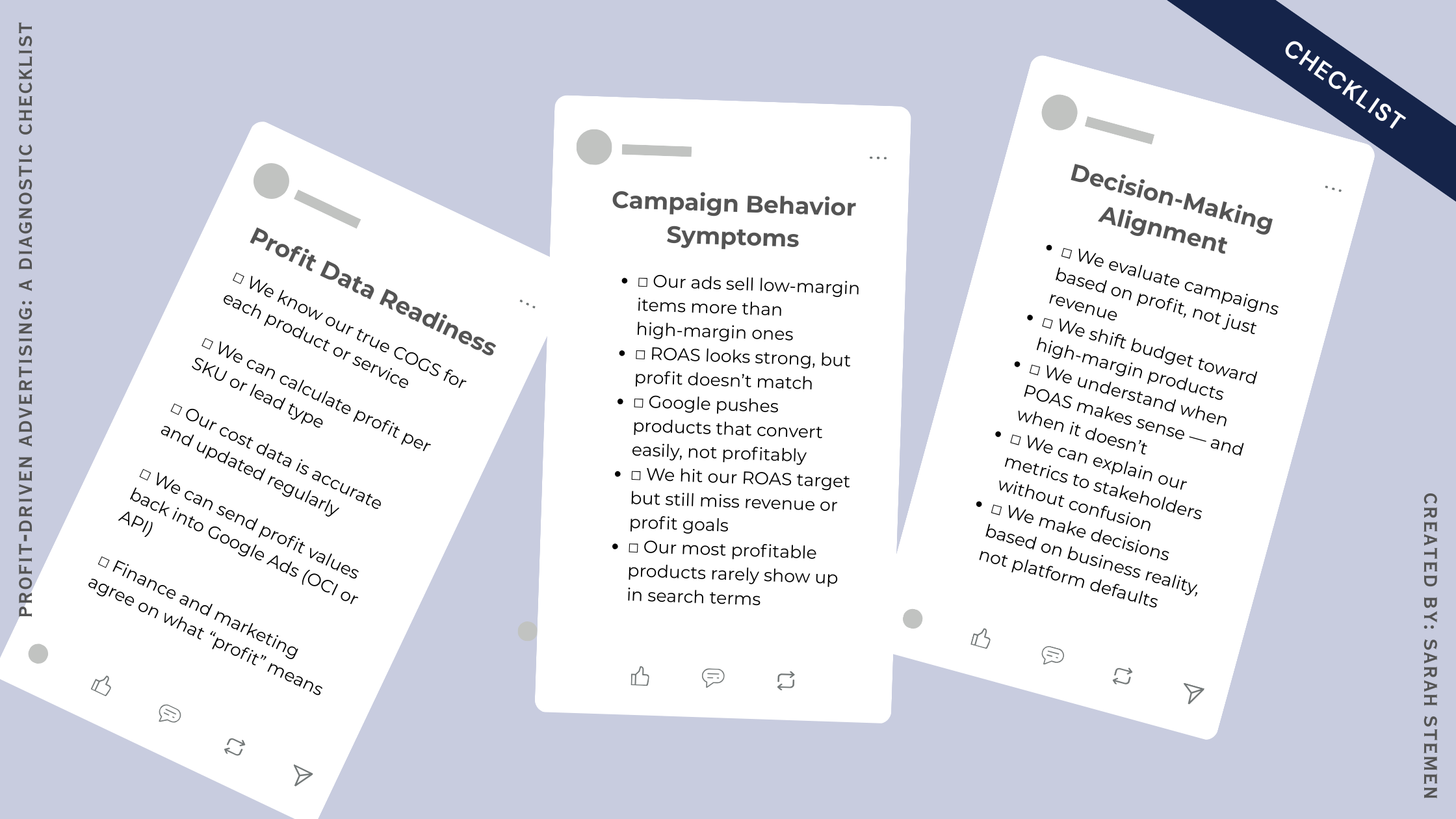
Use this checklist to diagnose whether your Google Ads strategy is aligned with profit clarity.Use this checklist to diagnose whether your Google Ads strategy is aligned with profit clarity.
The Challenges of Profit Optimization
Profit‑driven advertising is powerful, but it’s not effortless. Using profitability metrics is essential for understanding actual profitability, as they provide a clearer picture of whether ad spend is truly contributing to your bottom line. There are real challenges that businesses need to understand before shifting away from ROAS‑based thinking. Critical factors such as accurate cost data, margin analysis, and other business expenses must be considered for effective profit optimization.
1. You Need Accurate Cost and Profit Data
If your COGS or margin numbers are outdated or incomplete, the entire system becomes unreliable. Profit‑driven advertising is only as good as the data you feed it.
2. It Can Create a Short‑Term Bias
Optimizing for immediate profit can unintentionally deprioritize long‑term value — especially if you have products with high lifetime value or repeat purchase behavior. Profit clarity should support long‑term growth, not replace it.
3. It Requires Cross‑Team Alignment
Marketing, finance, and operations all need to be on the same page. Profit optimization isn’t a “marketing setting” — it’s a business decision. Smaller teams may need outside support to set up the systems correctly.
4. It Adds Cognitive Load
Profit‑based bidding requires more interpretation, more nuance, and more reframing. It’s not as simple as “ROAS up = good.” This is why POAS should be treated as an option — not a default.
The Bottom Line
Most campaigns don’t struggle because of poor marketing — they struggle because they’re optimized for the wrong outcome. A 300% ROAS on a high‑margin product can be far more valuable than an 800% ROAS on a low‑margin one.
When you shift from revenue to profit clarity, your advertising finally aligns with how your business actually makes money. Aligning advertising with business profitability ensures that your marketing campaigns drive real business value and support sustainable growth. Google’s algorithms are powerful, but they can only optimize based on the data you give them.
The Future of Advertising: Accountability
Profit‑driven advertising isn’t a trend — it’s a return to business fundamentals. It’s not about abandoning ROAS or blindly adopting POAS. It’s about choosing the model that reflects reality, supports your margins, and helps you make confident decisions.
Whether you use ROAS, POAS, or a blended approach, the goal is the same: every dollar should be accountable to profit, not just revenue. Evaluating advertising investments and online advertising through profit-focused metrics like POAS ensures better business outcomes by aligning ad spend with actual profitability.
A Diagnostic Invitation
If you’re unsure whether your campaigns are aligned with profit — or if the numbers in Google Ads don’t match what you’re seeing in your financials — it’s worth taking a closer look. Analyzing your campaigns for deeper insights and comparing performance across other marketing channels can reveal hidden opportunities for profit growth. Profit clarity is the difference between ads that look good and ads that actually grow the business.
Explore more posts that deepen your understanding of profit‑aligned advertising and Google Ads strategy:



Stop Guessing. Get Certainty.
You're running your PPC in-house now—the risk is yours. Before pivoting to profit-driven goals, you need a surgical diagnosis of your account's health.
The $750 Google Ads Audit
Schedule Your Diagnostic Audit Now